NGC Ancients: Bees
Posted on 5/12/2026
World Bee Day on May 20 is a chance to reflect on an insect that has played a key role in the environment and in human history. Honeybees, which were domesticated thousands of years ago, made regular appearances on coins of the ancient Greek world.
The main source of bees on ancient coins is Ephesus, a city devoted to the goddess Artemis, to whom bees were sacred. In this column we’ll focus on Ephesus, though bees appear as main designs of coins from several other mints in Greece, Crete, Asia Minor, and Phoenicia. Beyond this, they appear as secondary designs — usually issue symbols — on many other coins.
Here's the buzz on these fascinating coins!
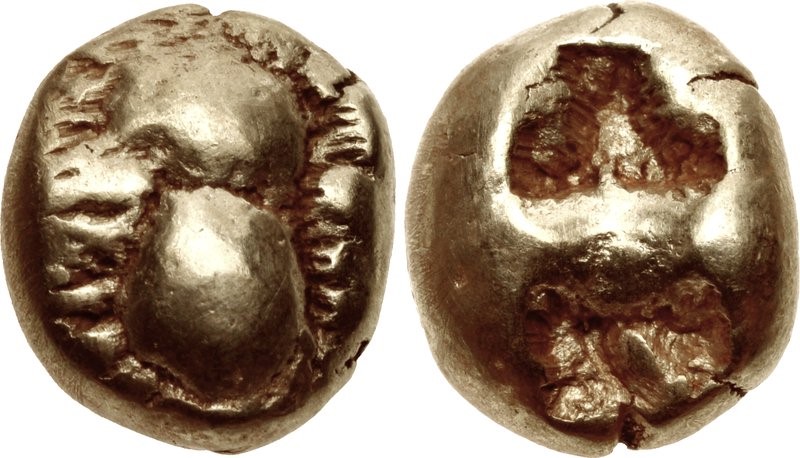 |
We’ll start in the beginning, with this Ephesian electrum sixth stater of c.600-550 B.C., which was struck centuries after the city was founded as a Greek colony on the coast of Ionia, in modern Turkey. Ephesus was renowned for its honey, and this coin, struck not long after the birth of coinage, includes a crude bee as its principal design.
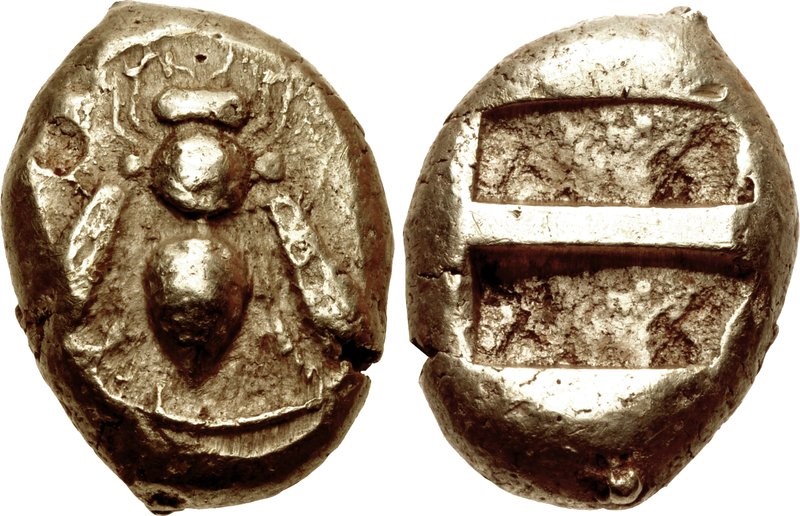 |
A rapid improvement in the artistry on coins is reflected in this electrum hemistater believed to be an issue of Ephesus, c.550 B.C. It was around this time that Ephesus and nearby Greek cities were defeated by the Persians and brought under their rule.
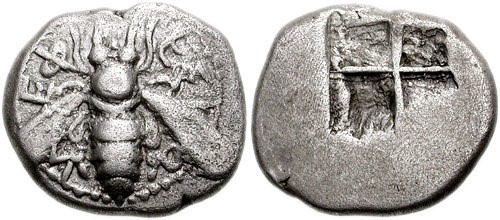 |
This Ephesus silver drachm showing a bee with curved wings was struck c.480-415 B.C. This time period was marked by regional conflict between the Persians and the Greeks allied under the Delian League, of which Ephesus was a member.
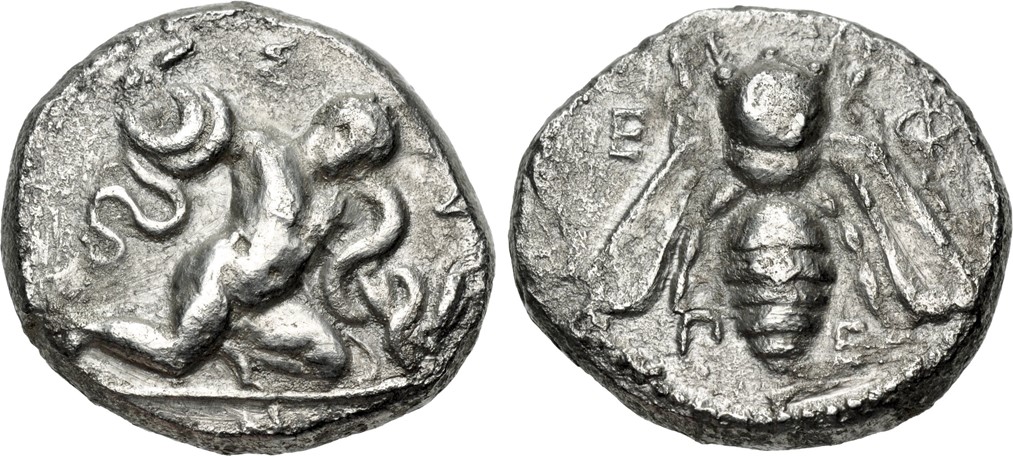 |
A fine example of symmachy coinage, which was produced by allied cities, this Ephesus silver tridrachm was struck 405/4 B.C. In this case, there is a common obverse among the issuing cities of the young Heracles strangling a pair of serpents, while the reverse types are specific to the issuing cities — in this case, at Ephesus, a bee.
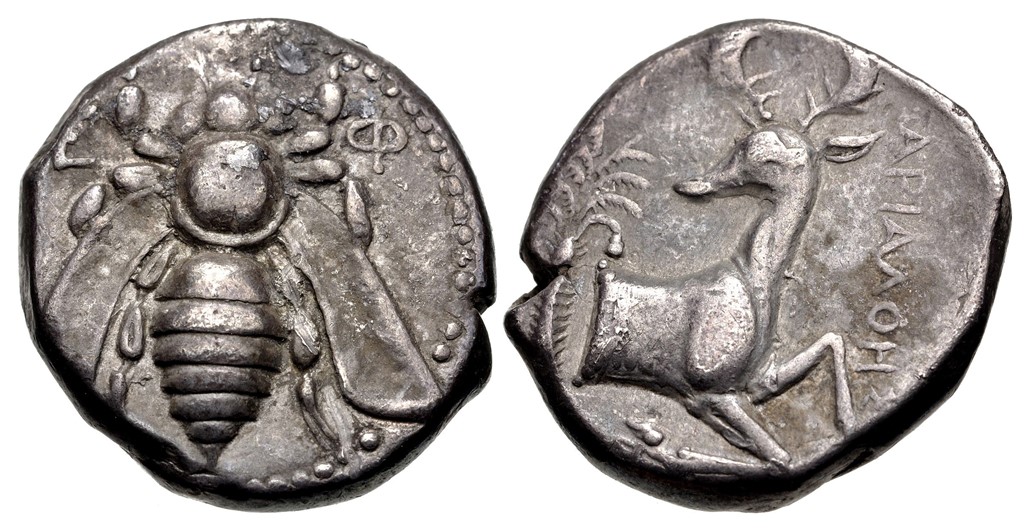 |
This Ephesus silver tetradrachm of the early 4th century B.C. shows on the obverse a bee with curved wings and on the reverse a palm tree and the forepart of a stag. The stag is another animal associated with Artemis, the goddess of the hunt, whose temple in Ephesus was so glorious that it was considered one of the Wonders of the World. (The coins of Artemis and her Roman counterpart Diana were the subject of last month's NGC Ancients column.)
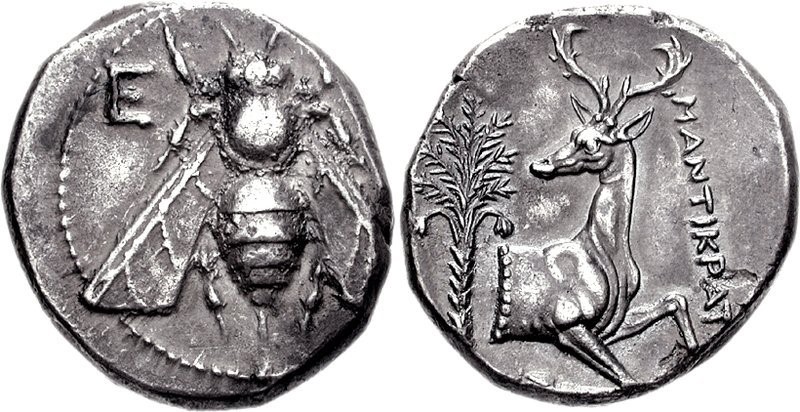 |
Shown above is another silver tetradrachm of Ephesus, this one struck later in the 4th century B.C. It has a similar design, though the bee now has straight wings.
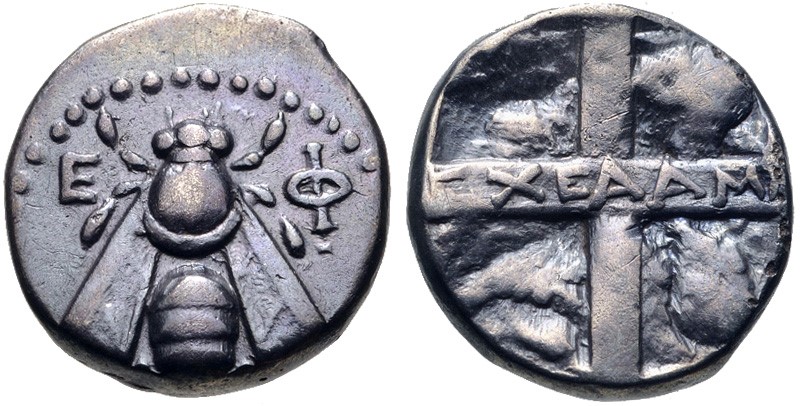 |
Like some of its predecessors, the design of this silver hemidrachm of c.340-330 B.C. includes the Greek letters epsilon and phi on opposite sides of the bee’s head, serving as an abbreviation for Ephesus. The reverse is a rough incuse punch with two raised bands, one bearing the name Echedam, a magistrate at Ephesus about the time Alexander III ‘the Great’ (336-323 B.C.) came to power in Macedon and invaded Asia.
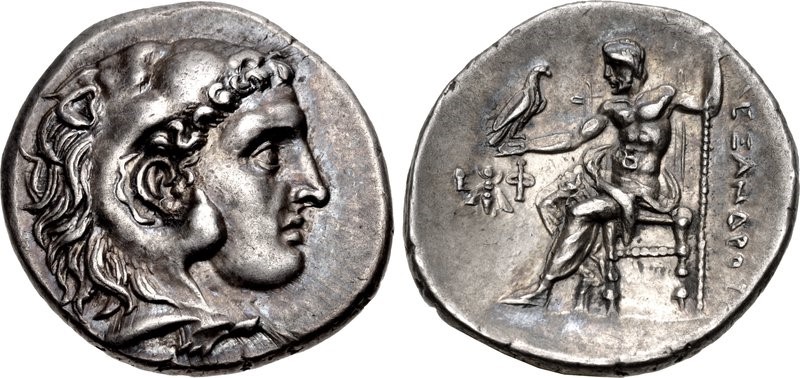 |
After Alexander’s death, one of his officers, Lysimachus, maneuvered to gain power in northern Greece and Asia Minor. This silver drachm struck for Lysimachus shows the head of Heracles on its obverse and the seated figure of Zeus on its reverse, replicating a design originally popularized by Alexander. The bee underneath Zeus’ outstretched hand (along with the epsilon and phi) identifies this coin as being struck at the Ephesus mint.
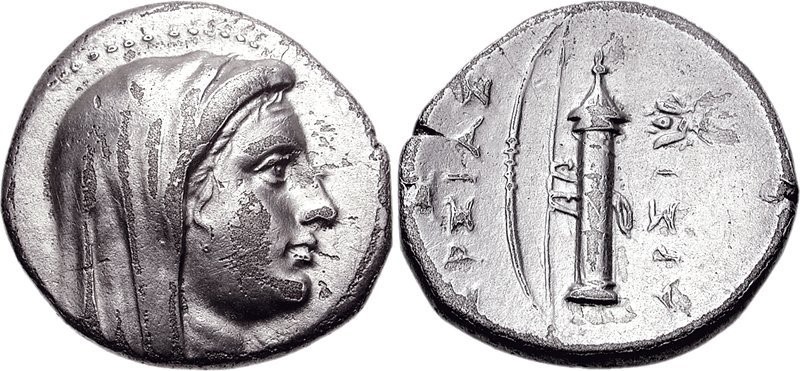 |
Lysimachus changed the name of Ephesus to Arsinoeia to honor his wife, Arsinoe II, the daughter of Ptolemy I, ruler of Ptolemaic Egypt. This silver octobol, struck c. 290-281 B.C., shows the veiled head of Arsinoe opposite a bow, quiver, and bee. While the marriage promised to create a powerful alliance, Arsinoe proved to be Lysimachus’ undoing when she convinced him to execute his own son — a callous act that appalled his regional allies and triggered an invasion that led to Lysimachus’ death in battle in 281 B.C.
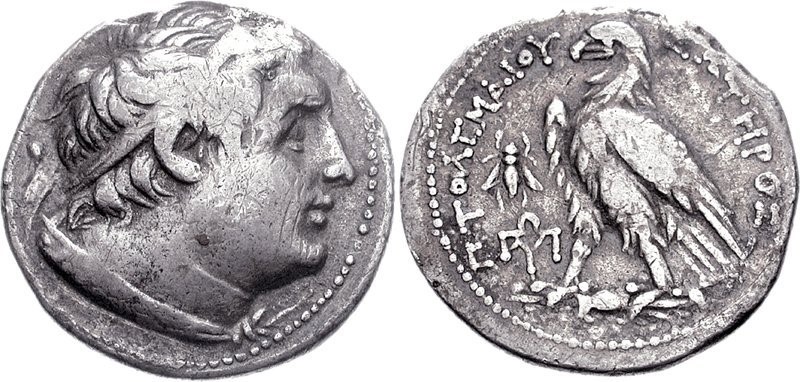 |
This silver tetradrachm of Ptolemaic Egypt was struck at the Ephesus mint for King Ptolemy III (246-222 B.C.). Ptolemy’s sister, Berenice, was married to a Greek king of the Seleucid Empire whose death triggered a succession crisis in 246 B.C. Amid the chaos, Berenice was murdered, and an enraged Ptolemy launched the Third Syrian War, which brought the Ptolemaic Empire to its zenith, gaining significant territory from the neighboring Seleucids, including Ephesus.
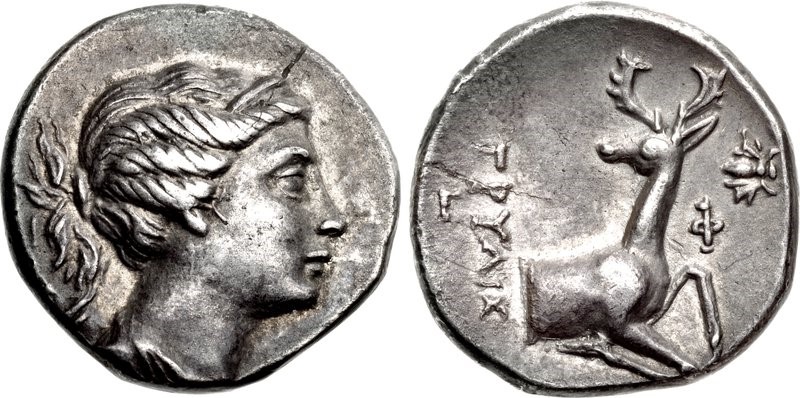 |
A scarce issue of Ephesus, this silver didrachm of c.245-202 B.C. combines four enduring symbols of the city: Artemis, her stag, a bee and the city’s ethnic.
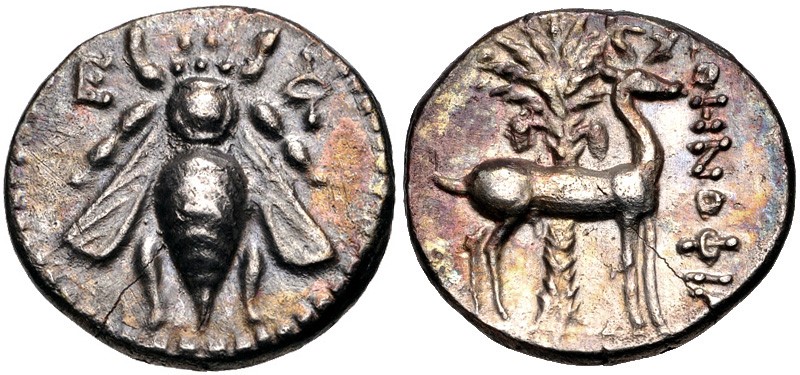 |
This silver drachm of c. 202-150 B.C. corresponds to the time when Ephesus changed hands repeatedly. The Seleucids took it back from the Ptolemies in 196 B.C., but within a few years, the Romans wrested it from Seleucid control, eventually taking direct control in 133 B.C.
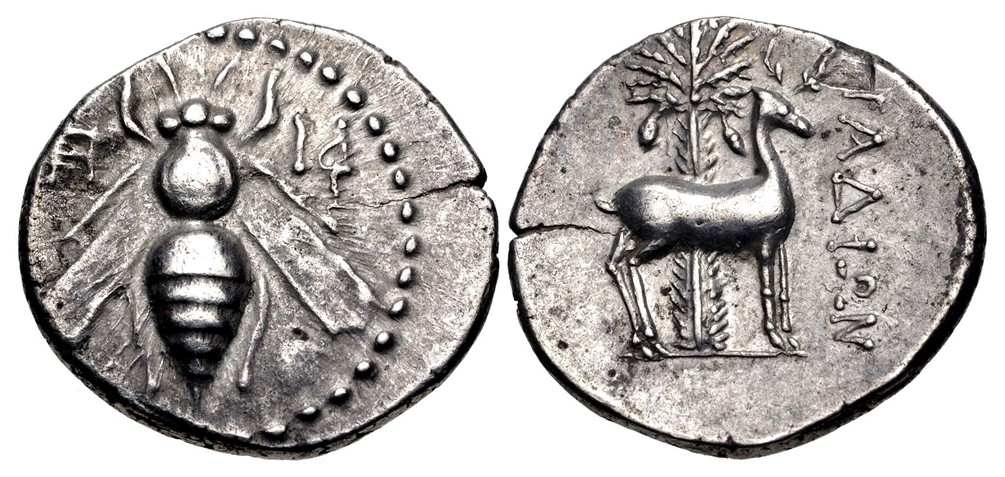 |
Though this silver drachm looks like a product of Ephesus, it was actually struck at Aradus in Phoenicia during the 2nd century B.C. These coins may have facilitated Aradus’ trade in Ionia.
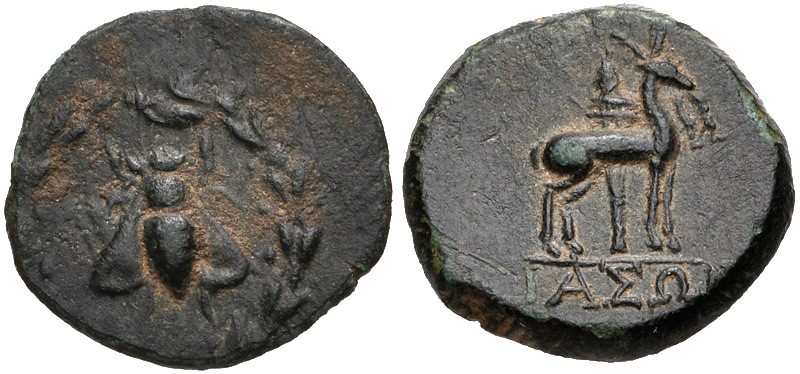 |
Rome’s high taxes laid the groundwork for Ephesus to rebel by welcoming the rule of Mithradates VI (120-63 B.C.), the King of Pontus, in 88 B.C. Subsequently, tens of thousands of Romans were slaughtered in the region, including many in Ephesus. He was defeated by the Roman general Sulla, who ordered Ephesus to pay a huge indemnity, causing economic hardship for decades. This base-metal coin struck in the aftermath, c.50-27 B.C., continues the theme of a bee opposite a stag.
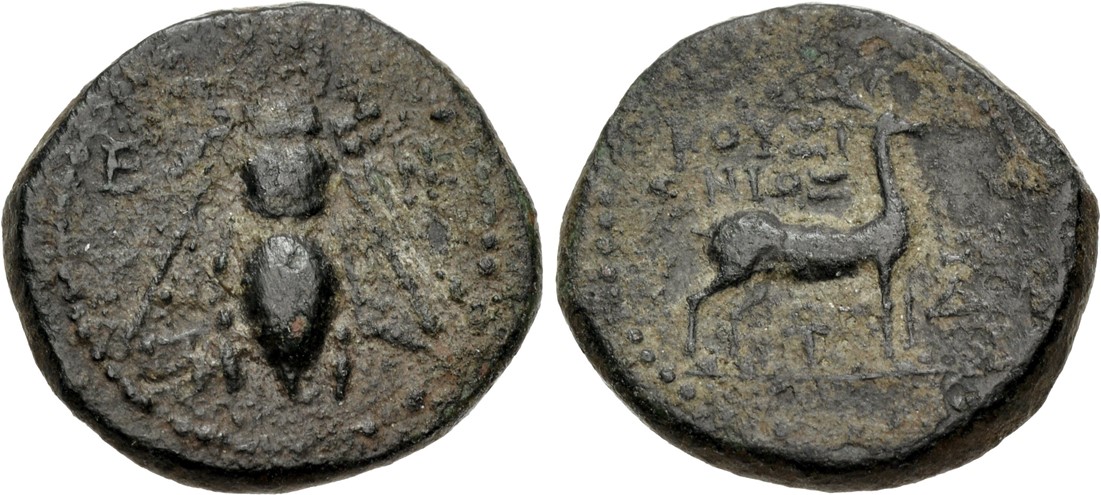 |
Coinage at Ephesus continued to be struck on a large scale when it, again, was under Roman control. This base-metal coin of Roman Emperor Claudius (A.D. 41-54) is among the last Ephesus coins known with this design combination.
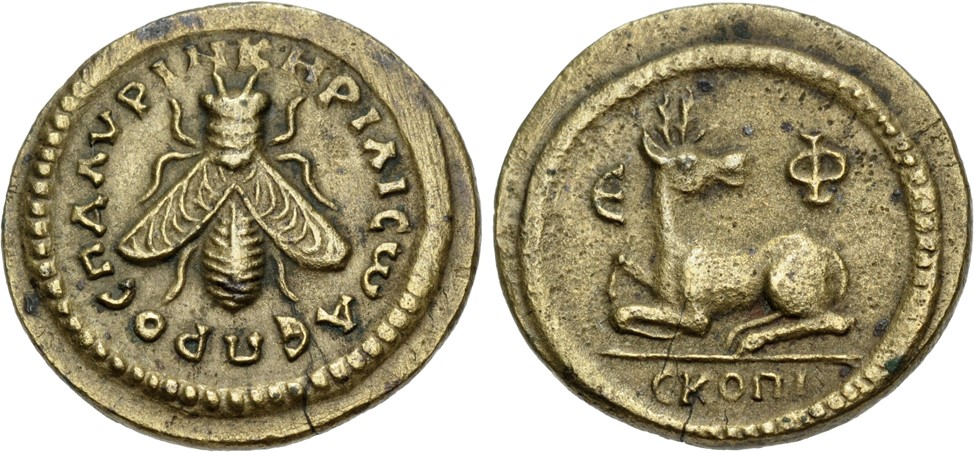 |
We’ll end this survey with two unusual items. First is a base-metal tessera, a type of token, struck in the 1st to 3rd centuries A.D. at Ephesus. Despite being under Roman rule, Ephesus maintained its influence as a major religious center because of the widespread following linked to its famous Temple of Artemis.
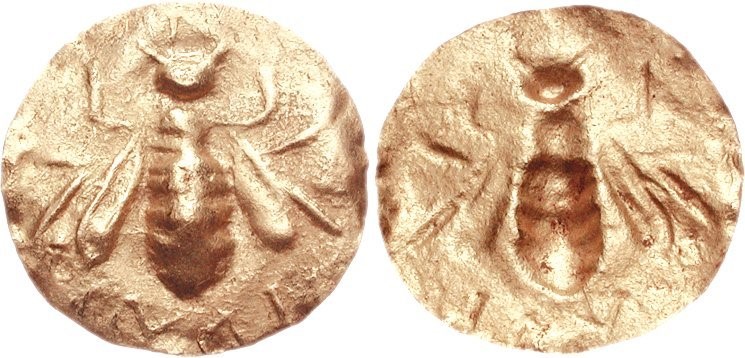 |
This gold token made sometime between the 5th and the 1st centuries B.C. has a bee design reminiscent of the Ephesus issues. It is thought to be a “Charon’s Obol,” which would have been placed with the deceased to pay Charon to ferry them across the River Styx in the afterlife.
Images courtesy of Classical Numismatic Group
