NGC Ancients: Libertas
Posted on 7/3/2026
The Roman goddess who personified freedom was Libertas. Those who held power (or were struggling to obtain it) used her as a powerful symbol of what their rule meant to their subjects. To lose a war could mean slavery for the defeated. Conversely, rights were often portrayed as flowing from benevolent leaders.
The symbol of Liberty long outlasted antiquity and found its way into the Age of Enlightenment as citizens sought to assert their rights. When the new United States was formed, one of the first laws was the Coinage Act of 1792, which required an allegorical figure of Liberty be placed on coinage in lieu of the portraits of kings that were so common in the day. These early American coins echo Libertas coinages of ancient times.
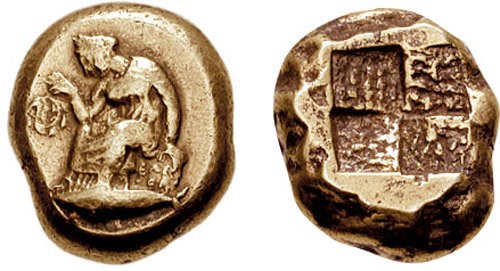 |
The Greek equivalent of Libertas was Eleutheria, a goddess who is depicted on this electrum stater issued at Cyzicus in Mysia sometime in the 330s B.C. Some attribute it precisely to 334 B.C. and relate it to the Macedonian King Alexander III 'the Great' (336-323 B.C.) liberating much of the Greek world from the dominion of the Persian Empire.
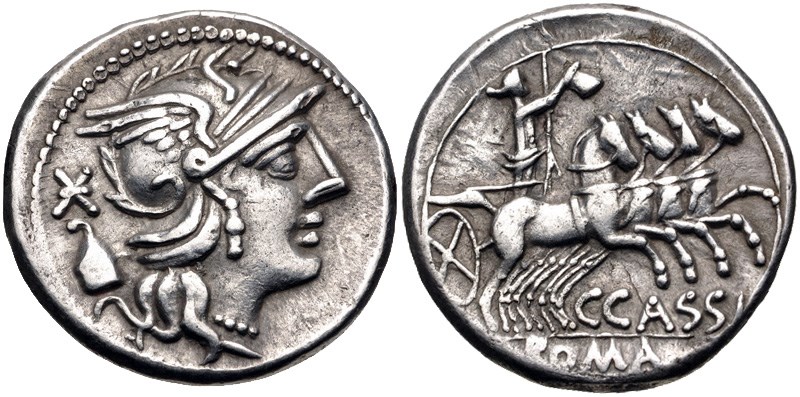 |
The first time Libertas is depicted on a Roman coin was on a silver denarius of the moneyer C. Cassius in 126 B.C. Opposite the head of the state-goddess Roma, Libertas is shown in a quadriga — a chariot of four horses. This moneyer had a powerful relative, a tribune of the plebs who a few years earlier had pushed for a legal reform that empowered jurors by mandating a secret ballot in many cases.
The aspiring young Roman who issued this coin celebrated his relatives’ accomplishment by framing it in terms of Libertas, who holds a conical cap called a pileus. It was an ideal symbol, as such caps were worn by a newly freed slave.
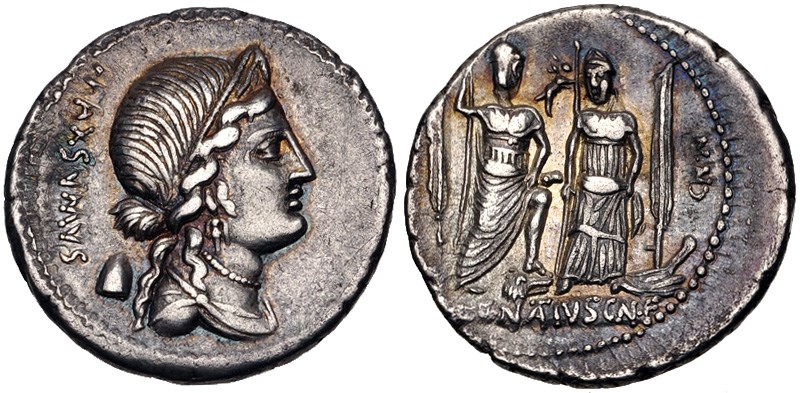 |
Half a century later, in about 76 B.C., the moneyer C. Egnatius Maxsumus depicted Libertas on three separate issues of silver denarii he struck at the Rome mint. The one above shows Libertas on the obverse, easily identified by the pileus behind her bust. The reverse shows the goddesses Roma (with her foot on a wolf's head) and Venus.
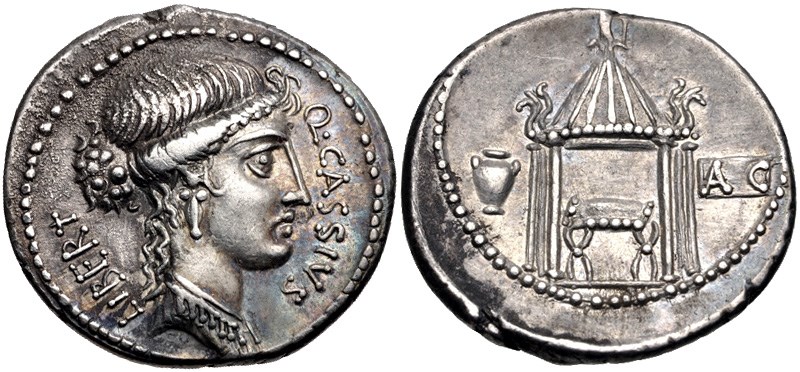 |
Libertas appears on the obverse of this silver denarius struck in c.55 B.C. by the moneyer Q. Cassius Longinus. This time, the goddess is not identified by a pileus, but by the inscription LIBERT. Believed to be a brother or a cousin of the Cassius who eleven years later would conspire to murder Julius Caesar, Q. Cassius Longinus was an ally of Caesar, even if an unreliable one whose rule as governor of Hispania was disastrous.
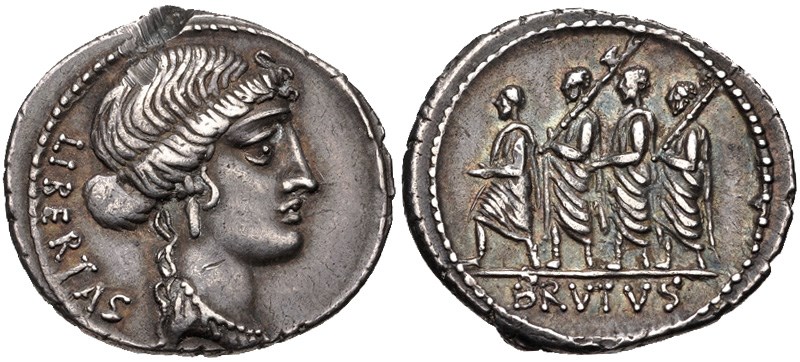 |
Another Liberty portrait is featured on the obverse of this silver denarius struck c.54 B.C. under the moneyer Q. Servilius Caepio Brutus — a man who was best known as the principal assassin of Caesar a decade later. The reverse shows a procession that includes one of Brutus' ancestors, L. Junius Brutus (second from right). According to Roman tradition, in 509 B.C. he helped overthrow Tarquinius Superbus, the last of seven legendary kings of Rome, ushering in the Roman Republic upon freeing Rome from tyranny.
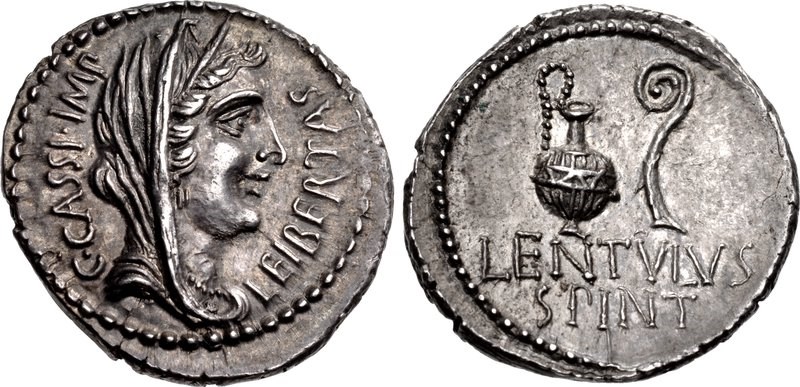 |
Fast forward to the Ides (15th) of March in 44 B.C., when Brutus and Cassius murdered Julius Caesar, then the most powerful man in Rome. The assassins viewed their act as necessary to preserve the Roman Republic against a man whom many believed wished to rule as a king. The silver denarius above, portraying Libertas, was issued by Cassius after the fact, in 42 B.C.
The murder sparked a civil war that pitted their faction, the Republicans (or the Liberators), against the Caesareans, who remained loyal to their slain leader. The Caesareans came to be led by a triumvirate of loyalists: Marc Antony, Octavian, and Lepidus.
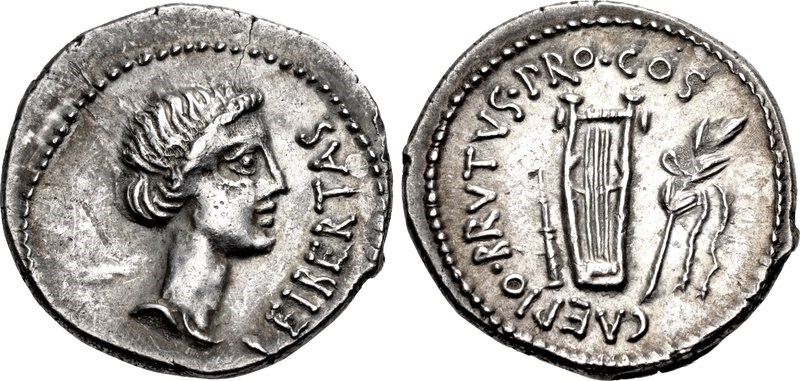 |
Cassius’ accomplice Brutus also issued silver denarii with the image of Libertas. Like the previous coin of Cassius, this one was struck by a military mint, which played an important role in keeping soldiers motivated in the looming war.
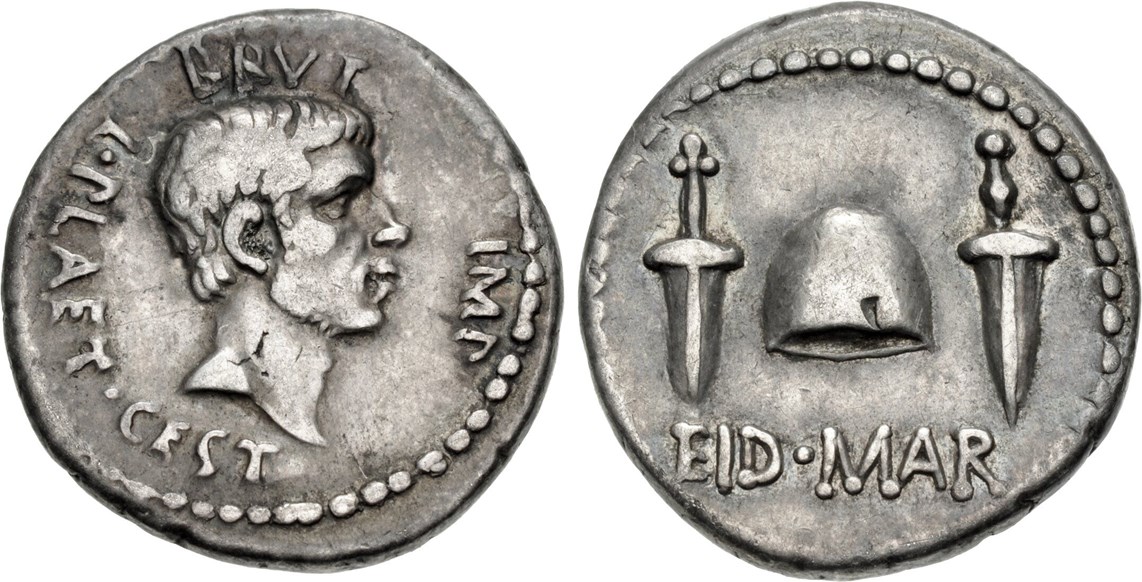 |
The most famous of all Roman coins is the silver Eid Mar denarius struck by Brutus in reference to his leadership in the murder of Julius Caesar on the Ides of March. The daggers represent the method of Caesar's assassination — one signifying Brutus, who is portrayed on the obverse, the other representing his co-conspirator, Cassius. Between them is a pileus, alluding to the liberty achieved on behalf of Rome. EID MAR appears prominently below, making it impossible for the meaning of the design to be misunderstood. This coin was issued shortly before Brutus and Cassius were defeated in the fall of 42 B.C. at the Battle of Philippi, which left both men dead.
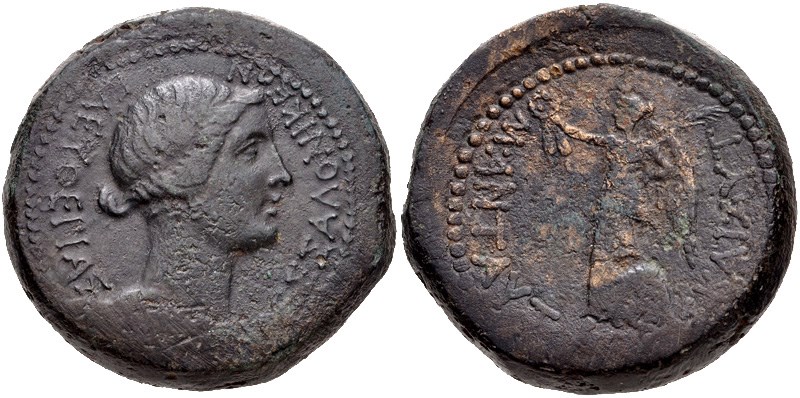 |
This base metal coin portraying Eleutheria on the obverse was struck at Thessalonica in northern Greece in about 37 B.C., a time when relations were souring between two of the triumvirs, Marc Antony and Octavian (who eventually became Emperor Augustus). After the Battle of Philippi, these two men emerged as Rome's most powerful men. Antony drew his strength from the East, including the Greek world, which by then was firmly under the Roman sphere of influence.
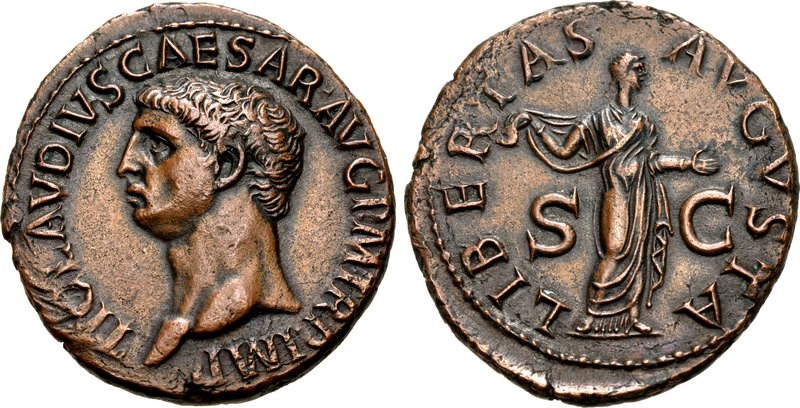 |
Libertas was featured on the reverse of a number of coins of Imperial Rome, including this copper ‘as’ portraying the emperor Claudius (A.D. 41-54). She is shown holding her trademark pileus.
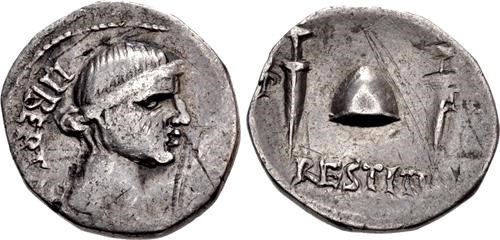 |
Civil war returned to Rome in A.D. 68 after the emperor Nero was forced to suicide. This denarius was struck in Spain under his successor, the emperor Galba, who reigned briefly before being assassinated. This coin echoes the theme of the EID MAR denarius of Brutus, but is easily distinguished by its crude style and fabric and the word RESTITVTA in place of EID MAR.
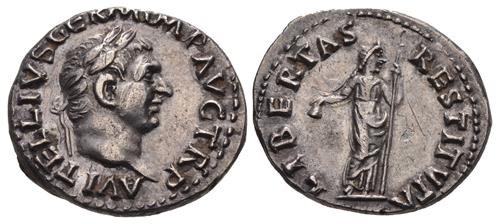 |
This silver denarius was struck in A.D. 69 for the emperor Vitellius, who also briefly reigned during this civil war. It shows his portrait opposite Libertas holding a pileus and a rod called a vindicta. Like the pileus, the vindicta was part of the emancipation ceremony, being used to tap the slave on the head to mark their transformation to a free person. The reverse continues the hopeful RESTITVTA theme of the previous coin, but Vitellius' reign lasted less than four months.
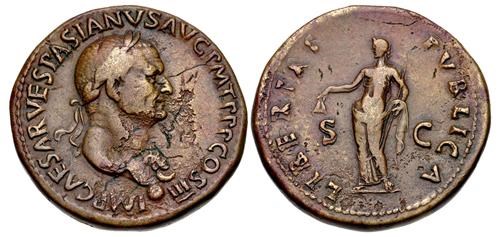 |
It was the general Vespasian who brought an end to the violence of A.D. 69 — the infamous ‘Year of the Four Emperors.’ He then was confirmed emperor and re-established stable rule in his decade on the throne (A.D. 69-79). This brass sestertius struck for him shows LIBERTAS PVBLICA on the reverse.
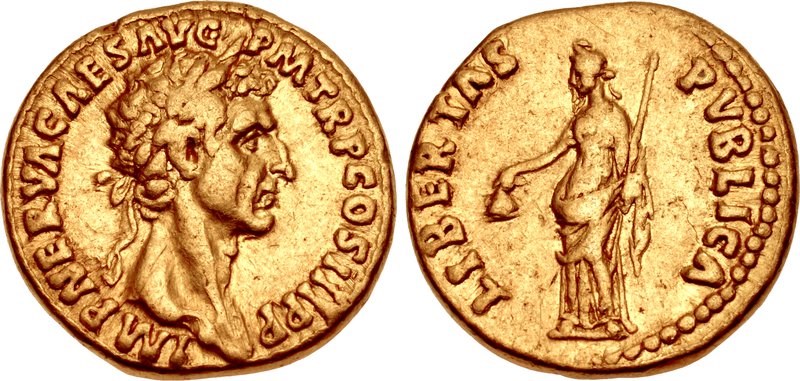 |
A rare example of Libertas on a gold coin is this aureus struck at the Rome mint under Emperor Nerva (A.D. 96-98).
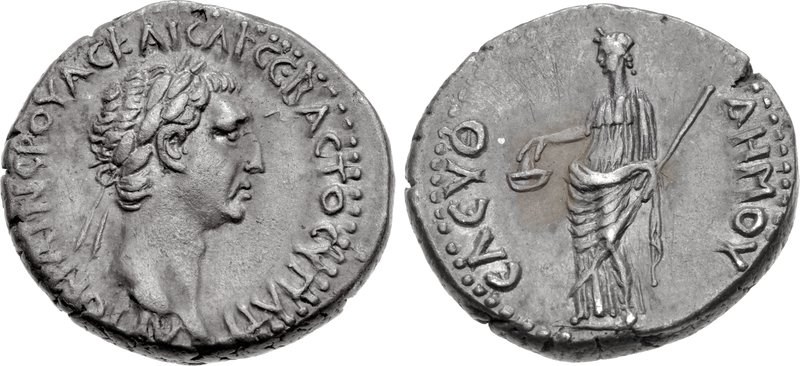 |
This provincial silver didrachm, also struck under Nerva, bears a design similar to the coin above. However, it is attributed to the mint of Caesarea in Cappadocia and has Greek inscriptions in place of Latin.
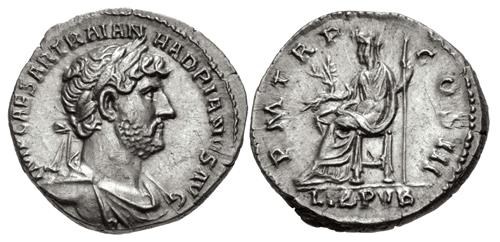 |
Liberty is seated on the reverse of this silver denarius struck for the emperor Hadrian (A.D. 117-138). This time the goddess holds a branch and a scepter, and is identified by the abbreviated inscription LIB PVB (‘Libertas Publica’).
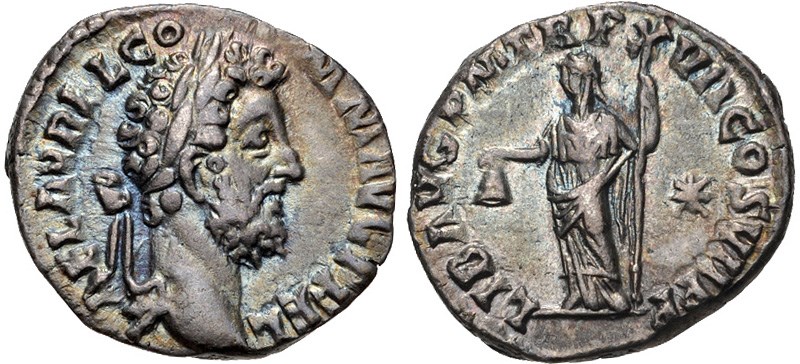 |
The theme of Libertas continued even under the emperor Commodus (A.D. 177-192), who issued this silver denarius near the end of his erratic rule, during which ‘liberty’ was not a sentiment commonly held.
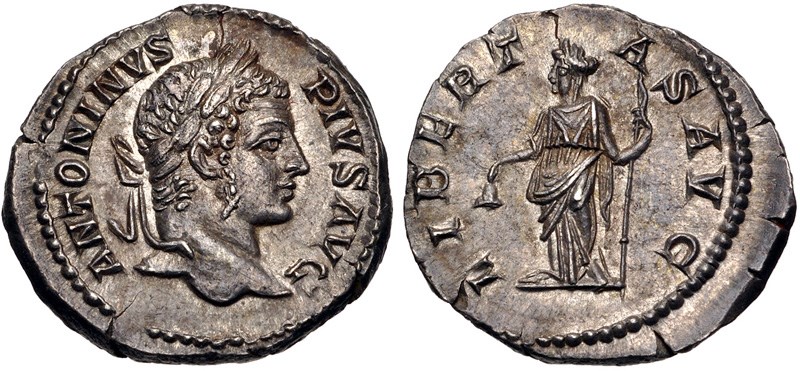 |
Another example of Liberty juxtaposed with a stern emperor is this silver denarius struck for the emperor Caracalla (A.D. 198-217). His rule began with the murder of his brother and co-emperor Geta.
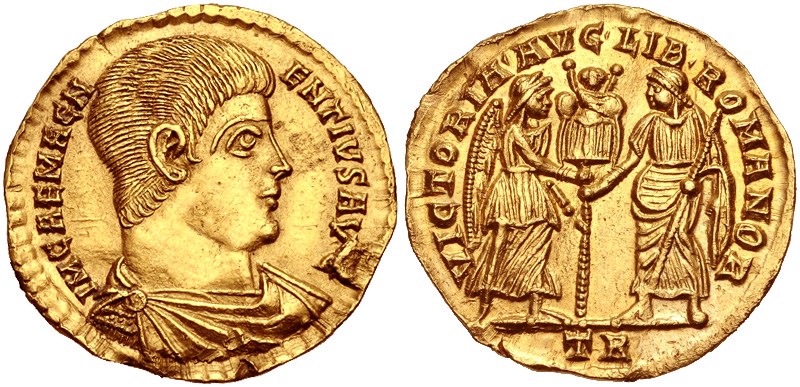 |
A Roman soldier's fortunes often depended on success in battle, and at no time was that more evident than during civil wars. This gold solidus was struck under Magnentius (A.D. 350-353), who rebelled against the legitimate emperor Constans (A.D. 337-350) and for a time assumed control of Rome’s western provinces. The reverse shows Libertas and Victory shaking hands, underscoring the risks and rewards for those who fought on his behalf. Constantius II, the brother of Constans, eventually defeated Magnentius and persecuted his supporters.
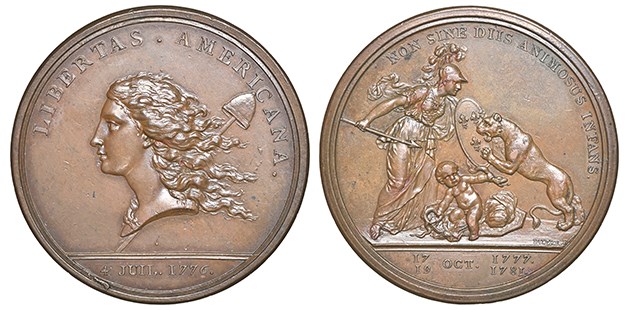 |
The perfect way to end this overview is with a ‘Libertas Americana’ medal. Libertas appears on the obverse of the historically important medal bearing the date of July 4, 1776, marking when the Declaration of Independence was signed. This month, the United States marks the 250th anniversary of this event. Founding Father Benjamin Franklin came up with the idea for this medal, which was struck in France in 1783, the year the American Revolutionary War ended with freedom for a new nation. The reverse shows Athena, representing France, protecting the young Heracles, representing the United States.
Images courtesy of Classical Numismatic Group and NGC.
