Jeff Garrett: Collecting Proof US Gold Coins
Posted on 4/16/2026
 |
One of the most alluring segments of the United States rare coin market is undeniably Proof US gold coins struck in 1915 and before. Classic Proof gold coins start at rare! Usually, only incredibly well-heeled collectors even attempt a collection of Proof gold coins.
At least a few mega-collectors are currently assembling complete sets of Proof Double Eagles. These magnificent coins start at around $150,000 in Gem condition. Many dates have auction records in the millions.
There have been many great collectors in the past who have assembled amazing collections of Proof US gold coins:
- King Farouk of Egypt (sold in the 1950s)
- Harry W. Bass (sold in the 1990s)
- The Garrett Family (no relation, unfortunately — sold in the late '70s and early '80s)
- Josiah K. Lilly (now in the Smithsonian Collection)
- J.P. Morgan (now in the ANS collection)
- Ed Trompeter (sold in the 1990s over several sales and some privately)
- John J. Pittman (sold in the 1990s)
- Childs (sold in the 1990s)
Today, collectors highly covet Proof gold coins, but they usually concentrate on buying individual issues when they appear on the market. Proof US gold coins are ideal for the “few great coins” collecting strategy. Most coins have extremely low mintages, and some issues may appear only once or twice every few decades. Occasionally, an original gold Proof set will appear on the market. These are usually sold individually and broken up to the highest bidder for each coin. Original matched Proof sets in gold are an endangered species.
History of Proof US Gold Coins
The first Proof US gold coins known to have been struck are the Quarter Eagles and Half Eagles of 1821. These coins are not fully mirrored, as is usually seen for later issues. The surfaces are more satin in appearance and slightly striated. Even though the coins look different, there is no doubt of their Proof status.
The US Mint struck Proof gold starting in 1821 and, incredibly, saved examples for future generations. The foresight of these early Mint employees is amazing and an incredible gift for our nation. In 1923, the US Mint collection was transferred to the Smithsonian Museum of American History. Many of these great coins are on display in the “Value of Money” exhibit at the Smithsonian.
Notes on Proof Gold Coin Issues
Early Bust Quarter Eagle and Half Eagle Coinage (1821-1838)

| An 1825 Quarter Eagle Proof |
1821 Quarter Eagles and 1821 Half Eagles are the first unquestionable Proof US gold coins. The surfaces are somewhat striated and lacking the typical mirrored surfaces that are usually associated with Proof gold coinage. Only five or six Quarter Eagles are known and just two examples of the 1821 Half Eagle are known, which are in the Bass Collection and the Smithsonian Collection.
Early Proof gold coins from this era are all very rare, and a majority of the known examples reside in the Smithsonian Collection (ex. US Mint Collection). Several issues are unique and only found in the Smithsonian’s National Numismatic Collection. Whenever an example of a Proof gold coin from this era is offered, it is usually considered an important numismatic event. I noticed that an amazing example from this era, a superb Gem 1837 Proof Quarter Eagle (one of just four known), is being sold by Heritage Auctions during the ANA convention this summer.
Liberty Head Gold Coins (1838-1907)

| An 1839 Liberty Ten Dollar Proof |
This group of gold coins includes Gold Dollars (Liberty and Liberty as Indian Princess), Quarter Eagles, Three Dollar (Liberty as Indian Princess), Four Dollar Stellas, Half Eagles, Ten Dollar Eagles, and Double Eagles. Liberty Head Proof gold coins range in rarity from unique to a few hundred known. The series is full of extreme rarities.
Historically, Liberty Head gold coins are only collectible from 1858 to 1907. 1858 is the year when complete Proof sets became more widely available. Several years ago, when many of the above collections were sold at auction, one of my clients assembled a complete set of US Gold Dollars (1856-1889) in Proof. I had the privilege of handling this collection again a few years ago when it was sold to the mega-collector Dell Loy Hansen.
For collectors with more limited means, Liberty gold coins in Proof offer some more affordable options. Proof Gold Dollars and Quarter Eagles can sometimes be purchased for $2,000 to $3,000 in lower states of preservation. Many of these have very low mintages and are a great value, in my opinion.
Indian Head Gold Coins (1907-1915)

| A 1915 Indian Quarter Eagle Proof |
Proof gold coinage from this era includes Indian Quarter Eagles, Indian Half Eagles, Ten Dollar Indians, and Saint-Gaudens Double Eagles. These coins are generally more available and sometimes seen as complete year sets. The Roman finish coins of 1909 and 1910 are particularly desirable.
Proof US Gold Coins at Auction
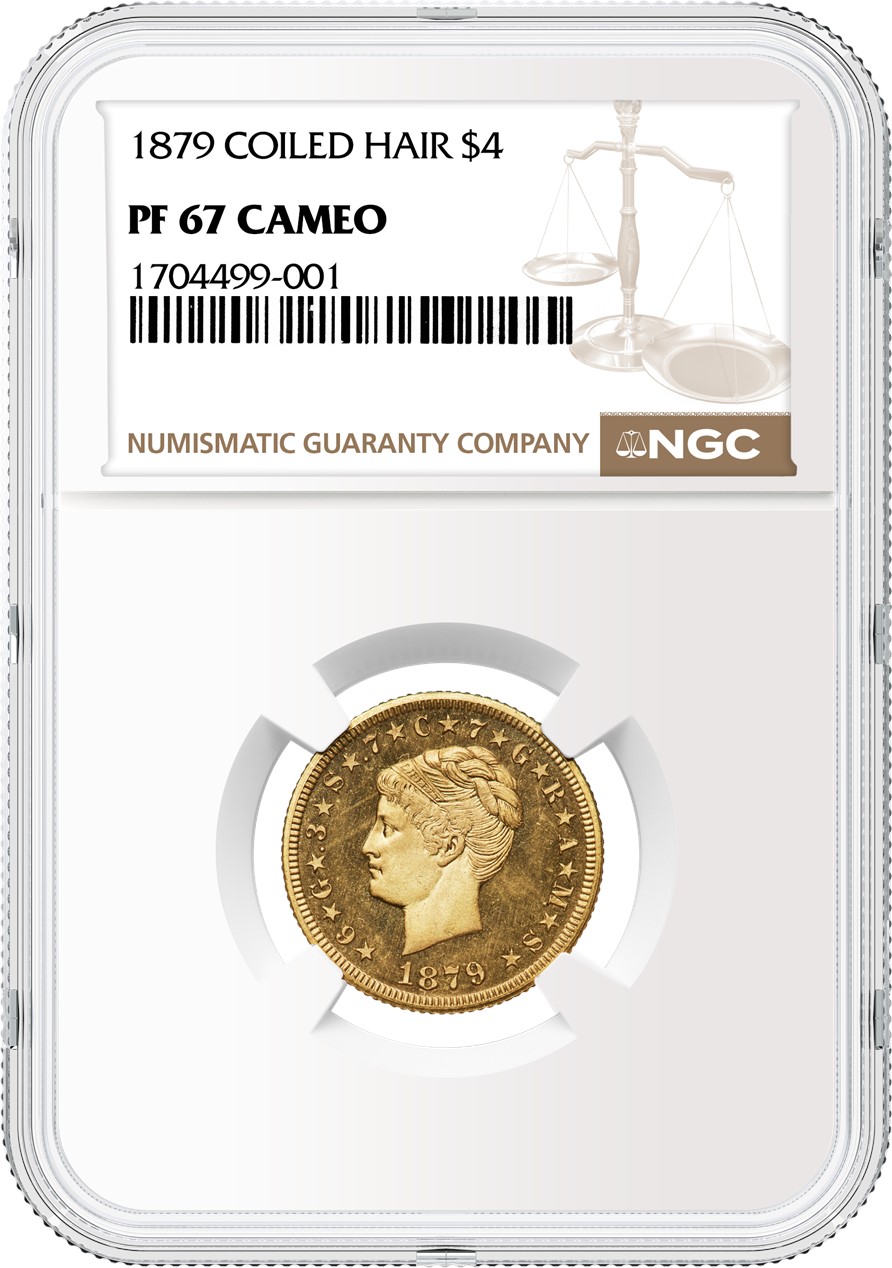
For those interested in buying Proof US gold coins, major auctions are one of the best options. Heritage has several amazing Proof gold coins in their Central States auction that will be held in a couple of weeks. My personal favorite will be the sale of a complete set of Stellas (1879-1880), Flowing and Coiled Hair. The 1879 Coiled Hair is of amazing quality and one of the finest known.
 |
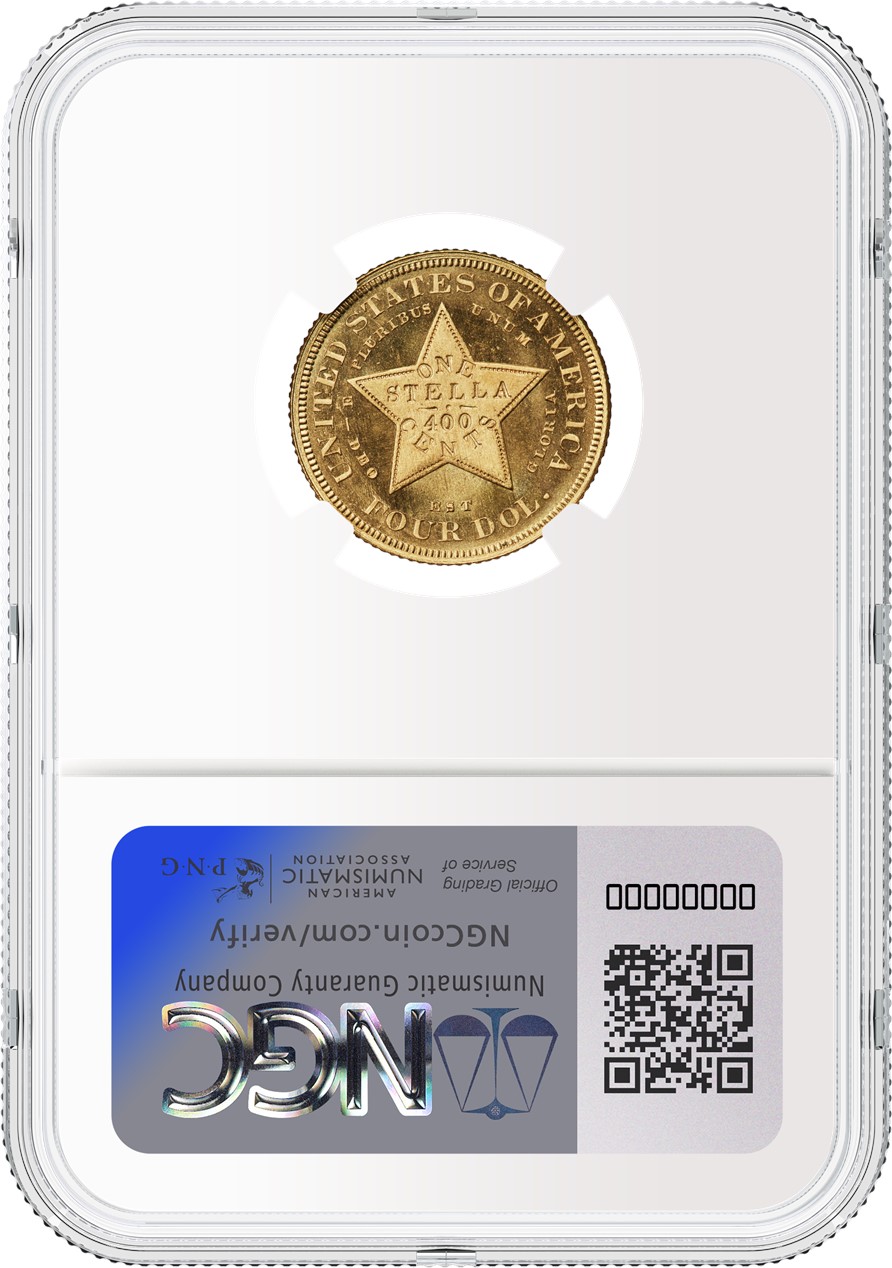 |
| The 1879 Coiled Hair Stella offered by Heritage Auctions. Click images to enlarge. |
|
The above barely scratches the surface on this incredible part of US coinage. For more information about this fascinating segment, I recommend my book, Encyclopedia of U.S. Gold Coins, 2nd Edition. The book has color illustrations of every Proof US gold coin struck from 1821 to 1915. Each coin is discussed in detail, with population information included as well. The book is out of print, but copies can sometimes be found online. Hopefully, the 3rd edition of this book will be published later this year.
Proof US gold coins are among the most beautiful US Mint products. Whether you choose to find one “great” coin, or assemble some kind of set, you will find the challenge exciting and rewarding. There is a reason these coins are called the “caviar” of numismatics — they are simply delectable!
Want to see more articles like this? Subscribe to the free NGC Weekly Market Report.
