Jim Bisognani: Spring Ahead with Coin Acquisitions
Posted on 3/26/2026
 |
Although I fear that Old Man Winter may still have some tricks up his sleeve (as he always seems to have), I say it is spring! Be gone! To further support this narrative — and I hope that old man gets the hint — most of the Major League Baseball teams are having their opening games today.
Yes, the proverbial boys of summer are at it once again. Wow, another season is gone and another beginning. I know time doesn't accelerate, but it does seem rather magical that another season is appearing right before my eyes.
It was only a year ago that I was marveling at the fact that gold spot had broken the $3,000 mark. Then, just last month, gold spot was trading in the mid-$5,000 range before the war in the Middle East took its toll on the world's life blood — oil. This, coupled with heightened inflationary fears, has gold retreating back to the mid-$4,000 level. While still respected as a safe haven, the metals (all the metals) are certainly more volatile. Now, as the war rages on, prospects for a peace accord remain hopeful, yet fleeting and mercurial.
Of course, many of my fellow coindexters have contacted me in this regard. Questions like, "Is it a good time to buy gold, silver, platinum or palladium, or should [we] wait?" My reply is, if you're buying metal purely as an investment, be wise and do dollar-cost averaging. If you're buying coins with numismatic value, that's an entirely different story and the one that I prefer to relay in this column. The joy of numismatics and collecting coins is still magical, even to this old geezer.
As I wax nostalgic, it's coming up on exactly 56 years ago that I attended a local coin show and bought my first coin with money that I earned doing chores around the house. What was my first acquisition, you ask? Well, it was a foreign coin — it was a South African 1963 50 Cent piece. The coin was silver dollar-size and Prooflike, or perhaps it was a Proof. Regardless, I just fell in love with the design of the springbok on the reverse. I paid $3.50 for that large silver coin. It certainly isn't a rarity, but it's still a coin that I have and enjoy, being my first real purchase at a coin show!
 |
Of course, I bought and traded for other coins with friends and from local coin dealer shops as well. Along the way, I had built a modest collection in my early teen years. Yet, attending that first coin show was something special. Now, as I turn the WABAC machine forward to today...
I have been involved in the numismatic field for over six decades. In that time, I've had the privilege to catalog common coins and rarities, analyze the US coin market via public and private sales and help maintain one of the most respected price guides and newsletters for US and world coins. Now, in the course of an average year, hundreds of millions of dollars’ worth of collector coins have hit the auction blocks via live sale and internet-only venues. Amazingly, today, a single major marquee sale will easily eclipse what used to be the total sales results generated for any given year when I was first starting as a coin collector!
Now, six-figure coin sales are commonplace, not only at major auctions but at coin shows through dealer-to-dealer or dealer-to-customer transactions as private sales. Today, even the excitement of a single coin realizing $1 million has become somewhat commonplace — or even blasé — even on the bourse. Back in my youth, the thought of a million-dollar price tag for a coin was unthinkable.
I mean, just a few years back before my purchase at the coin show, the record price paid for a coin was three years before (back in 1967) when dealer Aubrey Bebee paid $46,000 for a 1913 Liberty Nickel!
So even then, the prospect of a six-figure price paid for a single coin was perhaps a pipe dream. Yet that six-figure benchmark was attained only a few years later! And its celebrity was amplified through the magic of television!
In late 1973, I was a spirited young coindexter watching the conclusion of a family favorite show: Hawaii Five-O. My jaw dropped as the preview of the next week’s episode revealed it was going to center around a 1913 Liberty Nickel!
My parents always enjoyed that show, and Dad chimed in, "Hey, Jimmy, this is going to be right up your alley!"
I can't deny that my anticipation was indeed palpable. The episode of Hawaii Five-O, which had aired a few weeks before Christmas in 1973, was titled "The $100,000 Nickel." I recall telling some of my coin collector friends about the episode and they were all excited, vowing to tune in as well.
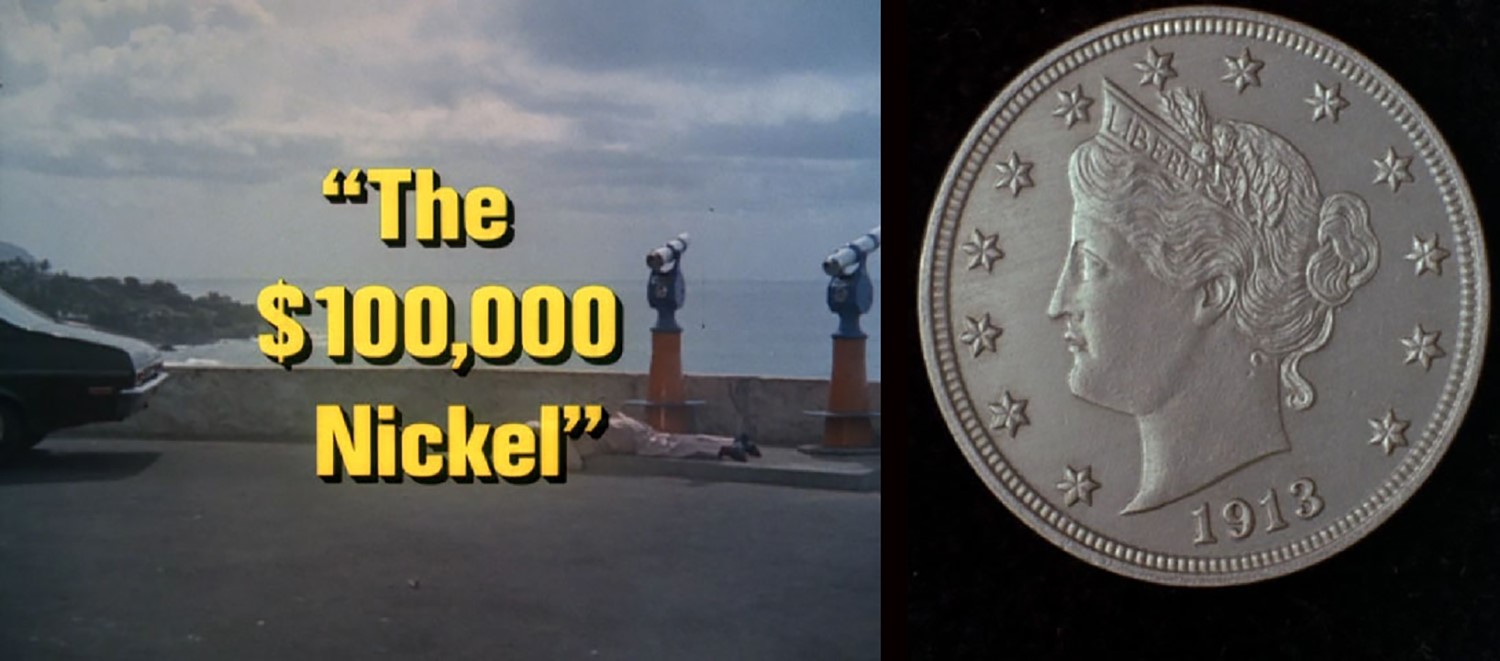 |
Considering that Aubrey Bebee had just paid the record price for any coin, which was $46,000 for one of the five 1913 Liberty Nickels six years before, it was an eye-opener for me. It meant that the famed 1913 Nickel's value had already more than doubled! When the Hawaii Five-O episode aired, other great US coins were featured, including an 1879 $4 Stella, the Round and Octagonal 1915-S $50 Pan-Pacs, a 1795 $10 and a few others. Wow!
The 1913 Nickel showcased in the episode was later graded NGC PF 64, pedigreed to Olsen and, of course, known as the Hawaii Five-O specimen. If you haven't seen the show, it's a numismatic must! If you have the chance to view the episode — which I strongly recommend — you'll note that all of the coins featured are "raw," as this episode was filmed more than a decade before the introduction of third-party grading and encapsulation of coins.
 |
|
Click image to enlarge. |
|
Thanks to the spread of third-party grading nearly 40 years ago, today's dealers, astute coindexters and the novice hobbyist can all take advantage of population reports and mull over related census data for coins they wish to acquire. The major grading services also supply price guides and track auction results from all of the industries' major players.
Now, given the transparency of the certified coin market, coin appearances can be tracked through auction sales. In many instances over the last decade or so, both iconic and type coins readily re-circulate amongst the major auction houses. Sometimes, the exact coin will make an appearance every year or so, with some making appearances even more frequently than that. With decades of preservation records, the trail is easy to follow, and coins that are truly rare immediately stand out due to low populations. After all, there are only a limited number of truly rare coins to compete for!
Accordingly, given their finite nature, it has become increasingly difficult to find a sale that truly offers both collectors and dealers an assortment of "fresh to the market," eye-appealing and rare coins. Certainly, there are instances of powerful and impressive pedigreed collections coming to market, such as the fabulous Garrett, Norweb, Eliasberg, Newman, Gardner and Pogue cabinets.
Time to break out wish lists!
For many dealers and collectors, coins from these cabinets are a priority in collections. Yet icons don't have to be pedigreed or come from a great named collection, or even command six figures or more. It all comes down to your taste and your budget. There are many glorious coins that can be bought for a few hundred dollars or less. While I occasionally help my fellow coindexters locate certain high-grade coins for their collections. I also see many a wish list from coindexters vying for type coins to fill their modest collections.
Consider the following list sent to me by Rick B., a coindexter hailing from Massachusetts. "Hey Jim," he said, "thanks for all your help. I still need to fill some holes... Obviously, the Bust 25 cent should be VG, the Barber Quarter a nice EF. Use your best judgement! The type Walker should be new BU, the Bust 50 Cents in Fine, etc... I don't want to spend a fortune on this!"
Other coins on Rick's wish list included:
- Flying Eagle Cents: 1856, 1857
- Indian Head Cents: 1864 (copper-nickel), 1864 'L', 1867, 1869, 1872-73, 1877-78, 1894-95, 1906, 1909-S
- Lincoln Cents: 1934-D, 1935-D and -S, 1941, 1942-S, 1943
- Liberty Head Nickels: 1886, 1890, 1892, 1898, 1900, 1906, 1912-S
- Mercury Dimes: 1916-D, 1918-S, 1920-S, 1921-D, 1923-S, 1924-S, 1925, 1925-D, 1928-S, 1929-D 1942/1
Other Items:
- $500 Note
- Pilgrim Half Dollar
- "Racketeer" Liberty Head Nickel
- Newburyport Notes
- 1937-D Buffalo Nickel - 3-Legged variety
- Revere Colonial currency
- Pine Tree Shilling
A quick scan of Rick's complete wish list finds that most of the coins are easily attainable at a modest cost. The biggest outliers would be the 1856 Flyer, the 1877 Indian Cent, the 1916-D Mercury Dime, the 1942/1 Mercury Dime, the 1937 Three-legged Buffalo, the Pine Tree shilling and, of course, the $500 Federal Reserve note. But when complete, Rick's collection will be a joy to not only own, but for others to appreciate. The diversity and eclectic nature make it a sight to behold.
Yes, my fellow coindexters. Now is the time to spring into action, and I can't think of a better way to start the new season than to reacquaint yourself with your coin cabinet, or to make some worthy additions.
Until next time, be safe and happy collecting!
Want to see more articles like this? Subscribe to the free NGC Weekly Market Report.
