NGC Ancients: Coins of Milan, Part 2
Posted on 3/17/2026
A mint was established at Mediolanum in northern Italy in the mid-3rd century, when Rome was still the capital of its eponymous empire. In the previous column, we began to explore coinage struck in what today is Italy’s second-largest city, Milan. Its fortunes have ebbed and flowed over the centuries, and it recently basked in the international spotlight that came with the Winter Olympic Games.
 |
Let’s pick up where we left off, with the Roman emperor Theodosius I (A.D. 379-395), who was selected to succeed Valens as the emperor in the East after the latter was killed in an ambush by the Goths in A.D. 378. Theodosius I reached a settlement with the Goths, then turned his attention to the West, where a usurper had killed his counterpart, Gratian (A.D. 367-383).
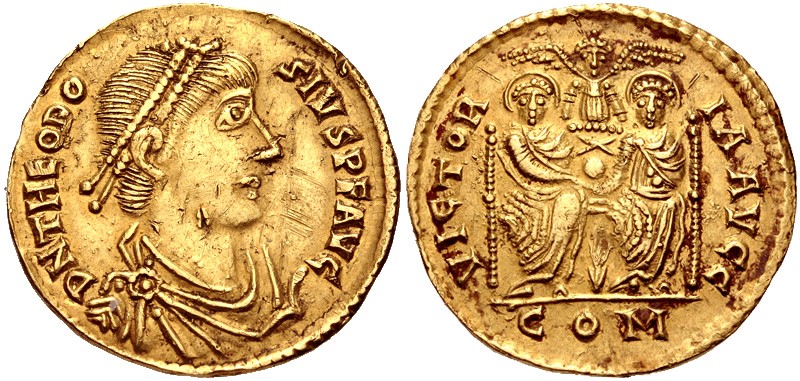
This coin, struck by an uncertain Germanic tribe, imitates a type of Roman solidus that would have been struck at Mediolanum (including the letters COM, one of its mintmarks). It demonstrates the broad influence of coins struck in Mediolanum at this time. The reverse shows Theodosius I and Gratian seated together, enthroned and sharing power.
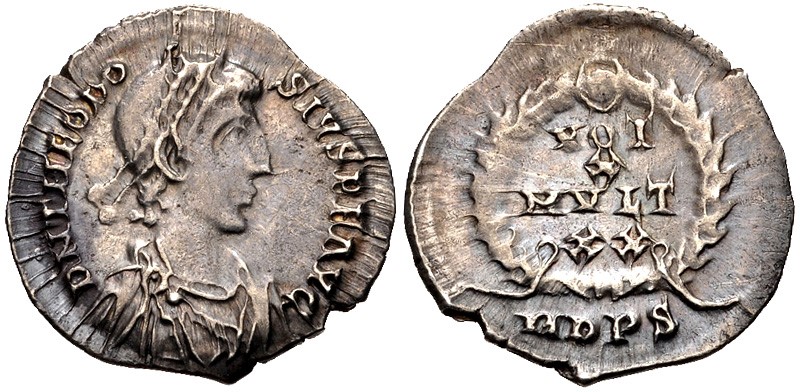 |
This silver siliqua showing Theodosius I was struck in Mediolanum around A.D. 387 to celebrate his first decade of rule. That year, the usurper Magnus Maximus, who had been content with ruling an area roughly corresponding to modern-day Spain, France and England, invaded Italy. He seized Mediolanum, forcing Valentinian II (A.D. 375-392), the young successor of Gratian, to flee. He sought refuge with Theodosius I, the emperor in the East. In A.D. 388, Theodosius’ forces defeated and killed Maximus, and Theodosius I moved his court to Mediolanum for several years.
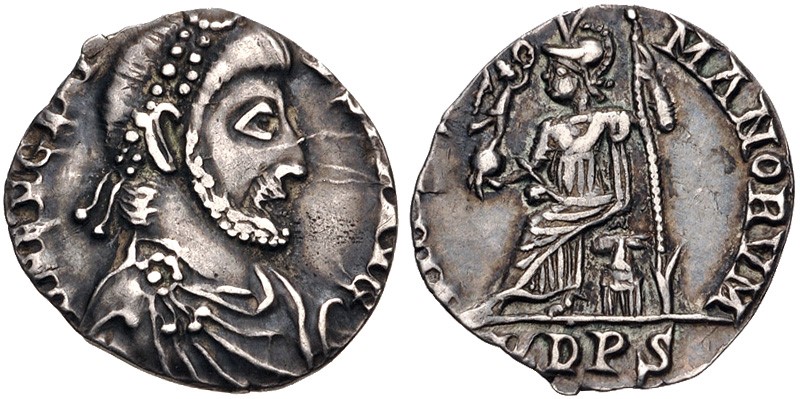 |
When Theodosius I returned to the East, he entrusted his general Arbogast with military command at the court of Valentinian II, which had relocated from Milan to southern France. Arbogast was openly defiant of the young emperor, who died in May of A.D. 392, presumably of murder. Suddenly uncertain of his future and recognizing that his Frankish background would not allow him to become emperor, Arbogast backed a Roman administrator named Eugenius (A.D. 392-394) as the new emperor in the West. He is shown on this silver siliqua struck in Mediolanum.
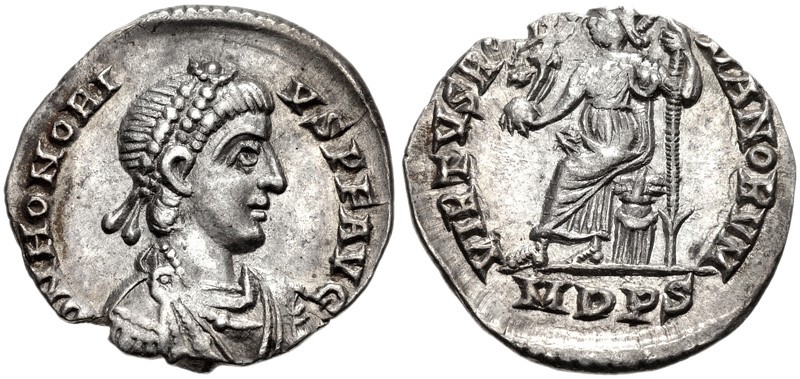 |
Theodosius I responded in early A.D. 393 by appointing his 8-year-old son Honorius (A.D. 393-423) (shown on this silver siliqua struck in Mediolanum around that time) the legitimate emperor of the West. This put Theodosius and his former ally Arbogast on the path to a civil war, which Theodosius won in September, 394.
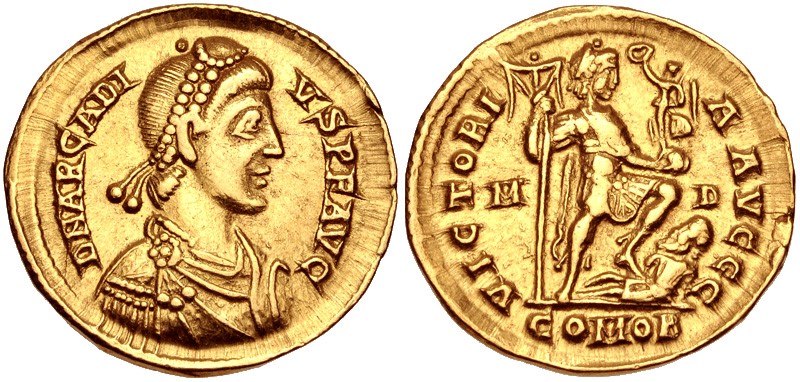 |
Theodosius I died a short time later, leaving his empire to two sons, the pre-teen Honorius and teenage Arcadius (A.D. 383-408). As merely a five-year-old, Arcadius was elevated to Augustus of the East in A.D. 383. He is shown on this solidus that was struck in Mediolanum ca. 397 to 402. The brothers did not get along, leading to a formal split in the empire between the East and the West.
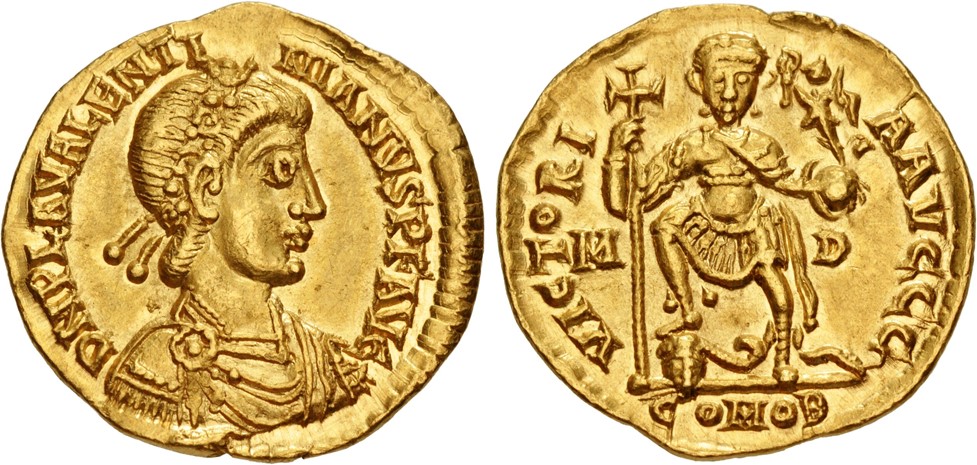 |
Honorius’ ineffective reign reached its nadir with the Sack of Rome in 410. Such an indignity had not happened for many centuries, and it was a severe blow to Roman prestige. When he died in 423, Honorius was succeeded briefly by a usurper Johannes, who was deposed a year and a half later by the Eastern Roman Emperor Theodosius II. With Theodosius’ blessing, his own half-cousin Valentinian III (A.D. 425-455) was installed as Western Roman Emperor. He is shown on this solidus, struck at Mediolanum as a new potent rival to Rome, Attila the Hun, gained strength.
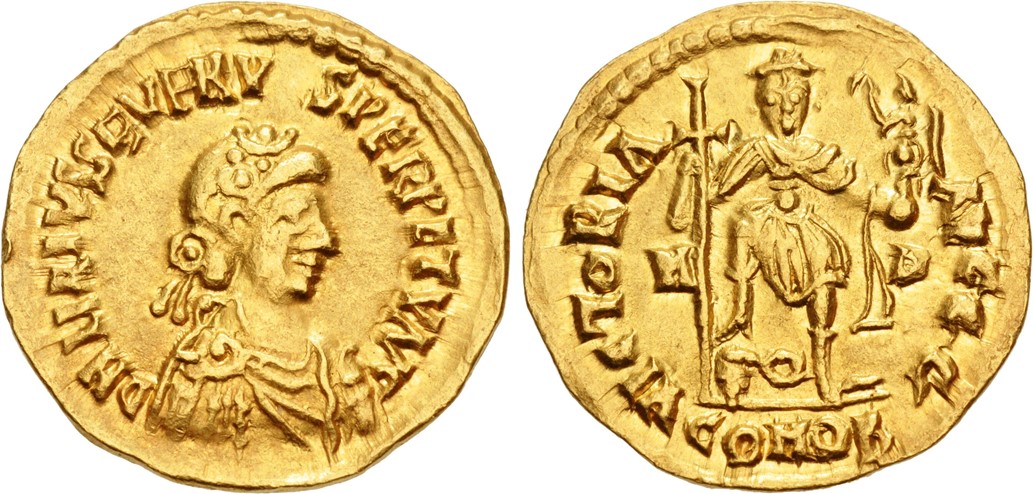 |
Amid this degradation in the West, a military official named Ricimer became prominent enough that for many years he raised and deposed emperors in the West. One of his puppets was Libius Severus (Severus III) (A.D. 461-465), who is portrayed on this gold semissis struck at Mediolanum.
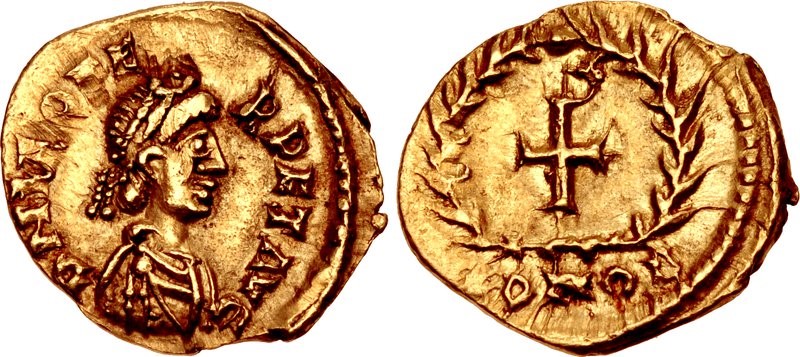 |
Leo I (A.D. 457-474), the Eastern Roman Emperor at this time, did maintain influence in the West, as shown by this gold tremissis struck at Mediolanum. After the death of Libius Severus, the throne in the West remained vacant until Ricimer and Emperor Leo I came to terms and appointed a new Western Roman Emperor, Anthemius (A.D. 467-472).
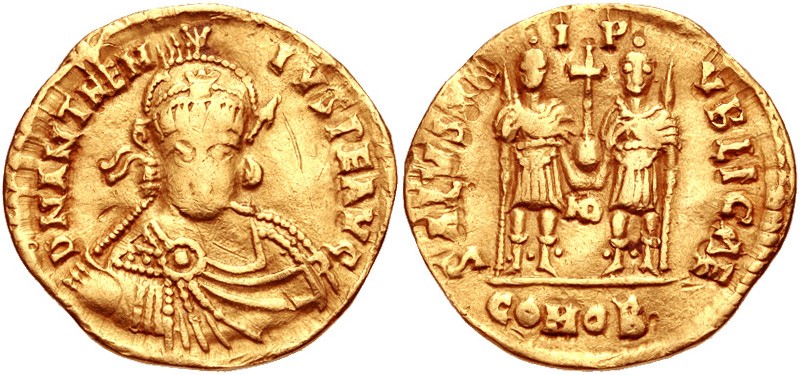 |
The facing portrait of Anthemius is shown on this gold solidus struck in Mediolanum. He is shown on the reverse with Leo, demonstrating unity between East and West, yet Anthemius went the same way as his predecessors, losing a power struggle with Ricimer.
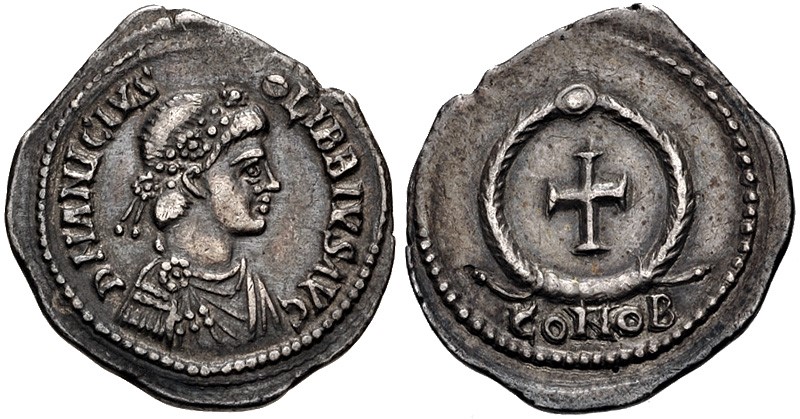 |
The next Western Roman Emperor, Olybrius (A.D. 472-474), is depicted on this coin that purports to be a silver tremissis struck at Mediolanum — however, it is a fake that was struck by the infamous counterfeiter Carl Wilhelm Becker more than 1,300 years after the originals.
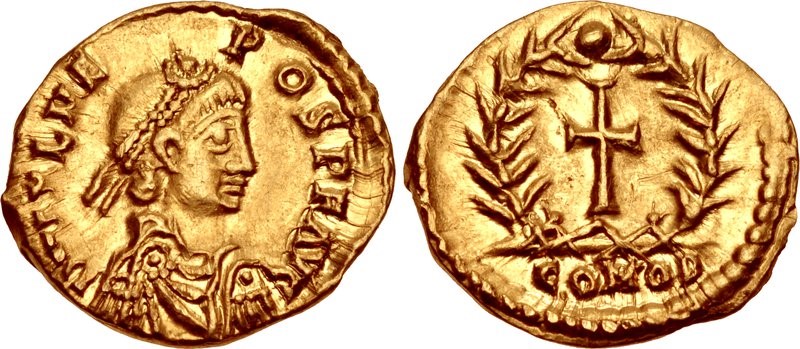 |
This gold tremissis struck in Mediolanum shows Julius Nepos (A.D. 474-475/480), who ruled the Western Roman Empire in its twilight years. He was deposed when the leader of his disgruntled army took control of the city of Ravenna, forcing him into exile to his native Dalmatia, where he was murdered several years later.
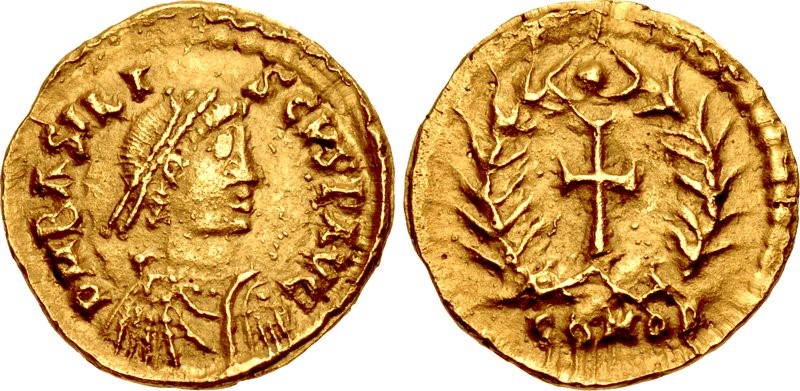 |
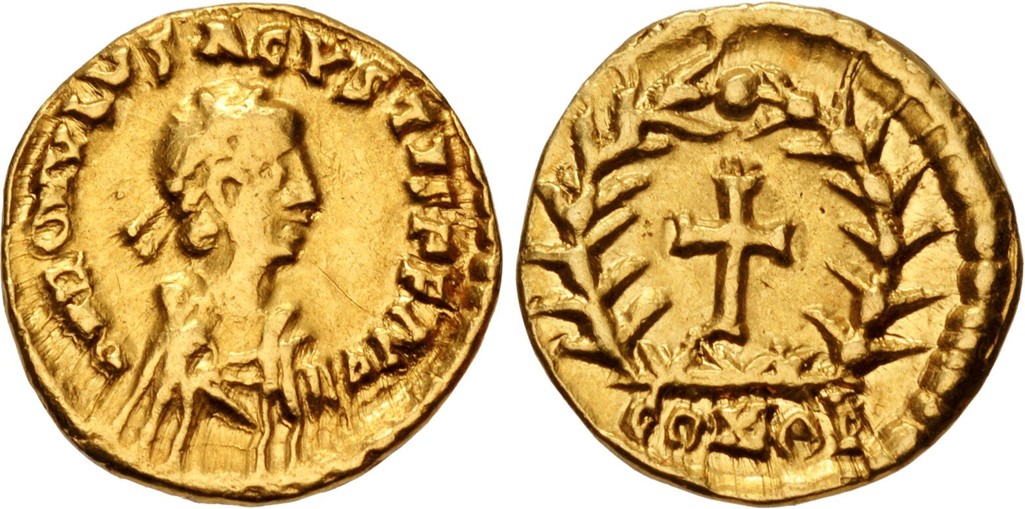
At this time, there was also political chaos in the east, where the nobleman Basiliscus (A.D. 475-476) usurped power in A.D. 475. This gold tremissis struck with the mintmark of Mediolanum shows Basiliscus, who soon was swept aside by Zeno, the emperor he’d replaced in a coup. As such, Zeno had two reigns: 474-475 and 476-491.
 |
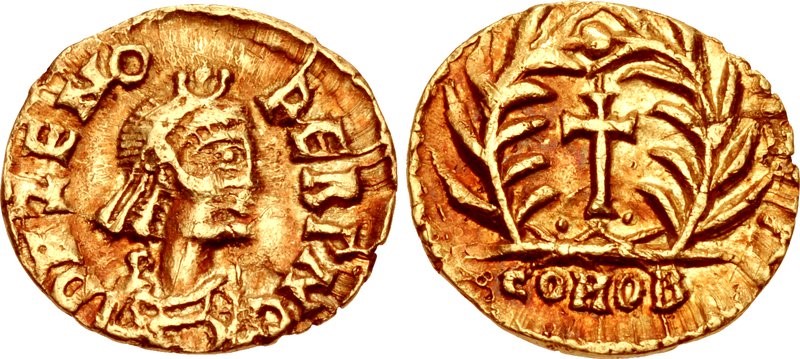
This gold tremissis struck in Mediolanum shows Romulus Augustus (A.D. 475-476), a youngster who most consider the last Western Roman emperor. The son of the man who deposed his predecessor, Romulus Augustus was the titular head of an empire that was a shadow of its former self with an army primarily made up of barbarian soldiers who were growing impatient to receive rewards they were promised. One of these soldiers, Odovacar (A.D. 476-493), defeated Romulus Augustus’ father and forced the young emperor to abdicate.
 |
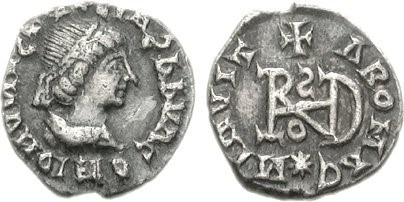
Rather than claiming to be the new Western Roman Emperor, Odovacar ruled Italy as a patrician, pledging loyalty to Zeno, which is reflected on this gold tremissis struck by Odovacar at Mediolanum in Zeno’s name. As Odovacar’s position improved, his relationship with Zeno grew frosty, and Zeno eventually dispatched a proxy to fight him.
 |
Theoderic, the king of the Ostrogoths and an ally of Zeno, fought Odovacar for control of Italy for several years. The hostilities ended with a truce brokered by the bishop in Ravenna, a peace that last only a few days before Theoderic slew Odoacer as they dined together. This silver quarter-siliqua stuck in Mediolanum was issued under Theodoric in the name of Anastasius I (A.D. 491-518), who modern numismatists consider the first emperor of the Byzantine Empire.
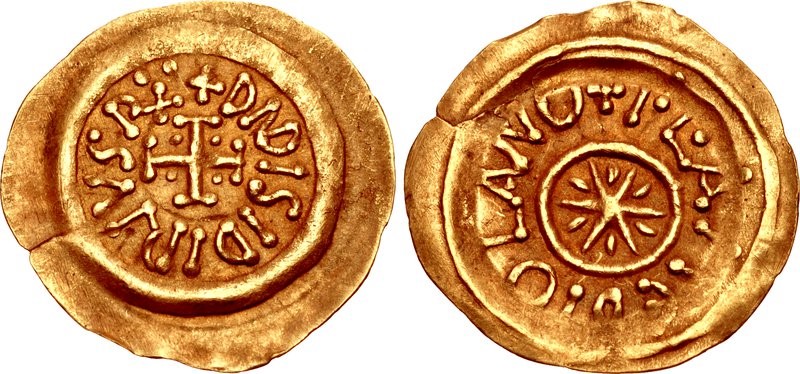 |
Coinage continued to be struck at Milan by a succession of rulers in northern Italy. These included the Lombards, who prevailed in the region for two centuries starting in A.D. 568. The last Lombard ruler was Desiderius (A.D. 756-774), who struck this gold tremissis in Mediolanum. He quarreled with the Papacy to his south and the Carolingians to his north, and ultimately was defeated by the Carolingian leader, Charlemagne.
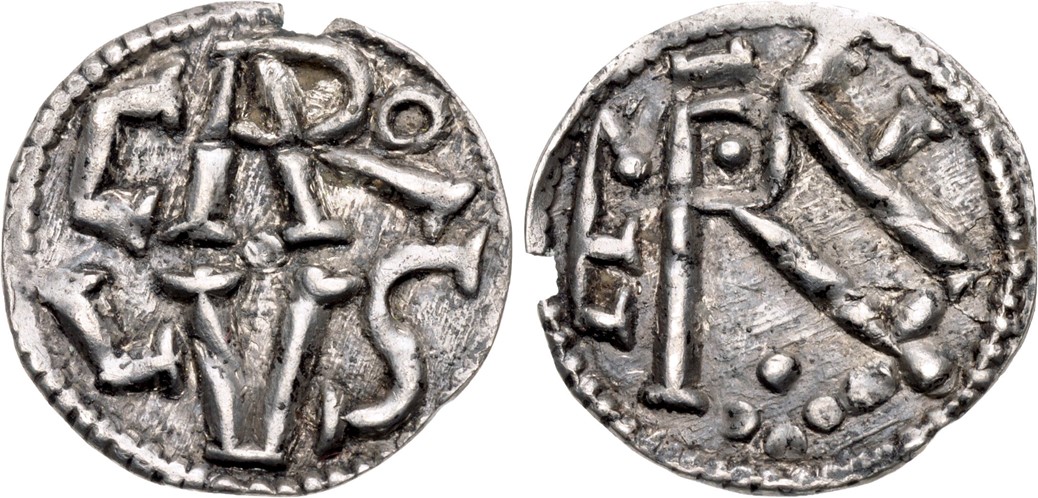 |
Charlemagne’s name appears on this silver denier struck at Mediolanum in the late 700s. He allied himself with the pope, was crowned Holy Roman Emperor and established more than a century of Carolingian rule over northern Italy.
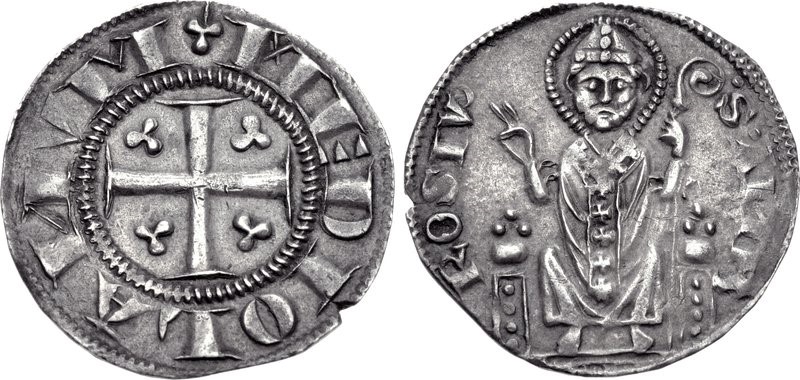 |
By 1300, Milan was one of the largest cities in Europe, perhaps second only to Paris. This silver soldo (struck A.D. 1250-1310) is from this era, called the Lordship of Milan. It shows the city’s patron saint, Ambrose, who was bishop of Milan nearly a millennium earlier during the time of the Roman emperor Theodosius I.
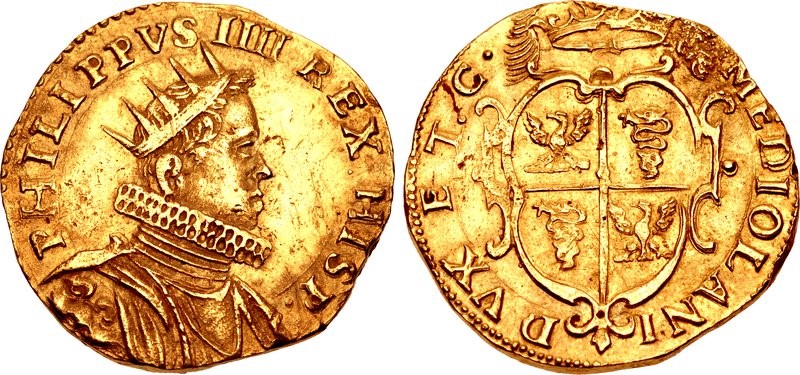 |
Milan found itself under Spanish rule from the mid-1500s until 1706. This gold double doppie shows Spanish King Philip IV (1621-1665). The city remained well-known throughout Europe: Two Shakespearean plays (The Tempest and Two Gentlemen from Verona) written around 1600 use Milan as a contemporaneous setting.
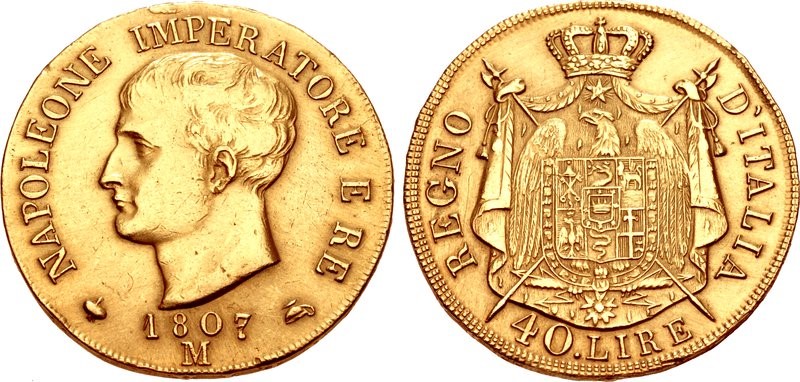 |
With dreams of creating an empire to rival Rome’s, the French emperor Napoleon I Bonaparte had himself coronated as King of Italy in Milan in 1805. This gold 40 lire was struck in Milan during his decade-long rule.
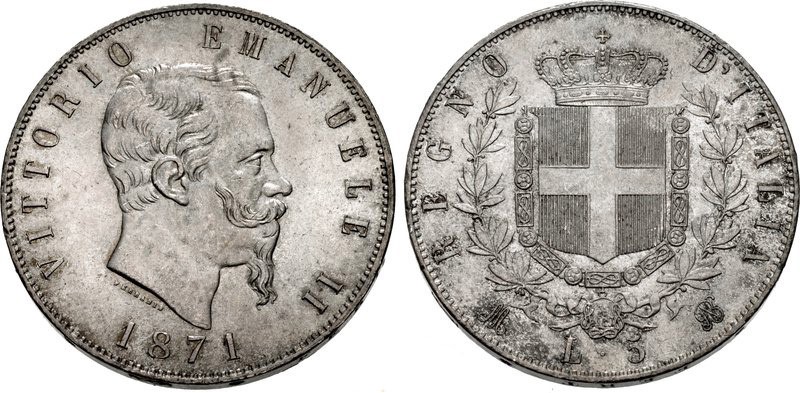 |
Coinage continued to be struck in Milan during the Reunification of Italy, a process that began in 1861 with King Victor Emmanuel II (1861-1878) acquiring much of northern Italy from the French, who had recently acquired it from the Austrian Empire.
This silver 5 lire showing Victor Emmanuel II is dated 1871, the year the king moved his capital to Rome after ending the Papal States, a fixture in central Italy for more than a millennium. It was several more decades before Rome, with its own rich historical legacy as an ancient capital, again became Italy’s largest city.
Today, Italy's main minting facility, the Istituto Poligrafico e Zecca dello Stato (IPZS), is headquartered in Rome. It is responsible for striking the euro coins used as Italy's official currency as well other numismatic items, including the 2026 Winter Olympic Medals.
Images courtesy of Classical Numismatic Group.
