NGC Ancients: Elephants
Posted on 8/12/2025
World Elephant Day is celebrated August 12 to bring attention to the plight of elephants. All three of the world's elephant species — the African bush elephant, the African forest elephant and the Asian elephant — are endangered.
Elephants have always been well-known for their strength and grace, but in ancient times they also were prized for their value in battle. Various Greek, Roman and Carthaginian coins feature elephants, with the following being excellent examples.
 |
This silver dishekel (or Tetradrachm) dates to late in the reign of Alexander III "the Great" (336-323 B.C.), who cobbled together an unprecedented empire before his death. Alexander's army encountered war elephants in 326 B.C. at the Battle of Hydaspes in modern-day Pakistan. The Greeks defeated the army led by the ancient Indian king Porus. This coin is thought to have been struck in Babylon, conquered five years earlier by Alexander.
 |
Following Alexander's death at the age of 32, his kingdom was divided among his lieutenants. This gold stater was struck under one of Alexander's generals, Ptolemy I (323-282 B.C.), founder of the Ptolemaic Kingdom based in Egypt. The reverse shows a chariot drawn by elephants.
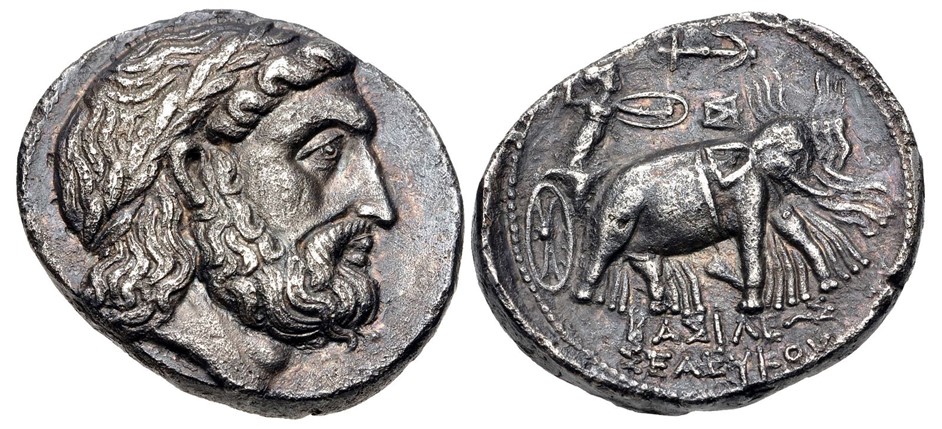 |
Another one of Alexander's generals, Seleucus I (312-281 B.C.), founded the Seleucid Kingdom, which stretched from the Aegean Sea to India. This silver tetradrachm, struck late in his reign, shows a chariot of four elephants fancifully adorned with horns, as well as tusks. An Indian ally provided Seleucus with hundreds of war elephants and riders, which were of great value in the Battle of Ipsus in 301 B.C.
 |
A large part of the easternmost territories of the Seleucid Kingdom broke off in the mid-3rd century B.C. to become the Kingdom of Bactria. This silver tetradrachm of ruler Demetrius I (c.200-185 B.C.) shows his portrait on the obverse with an elephant headdress, while the reverse shows Heracles with a club and lion skin.
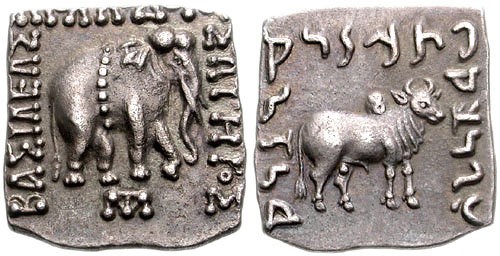 |
This silver square drachm struck for the Bactrian king Apollodotus I (c.180-160 B.C.) shows an elephant wearing a belt and a bull. The inscription on the obverse is Greek and on the reverse is Kharosthi, an ancient Indian script.
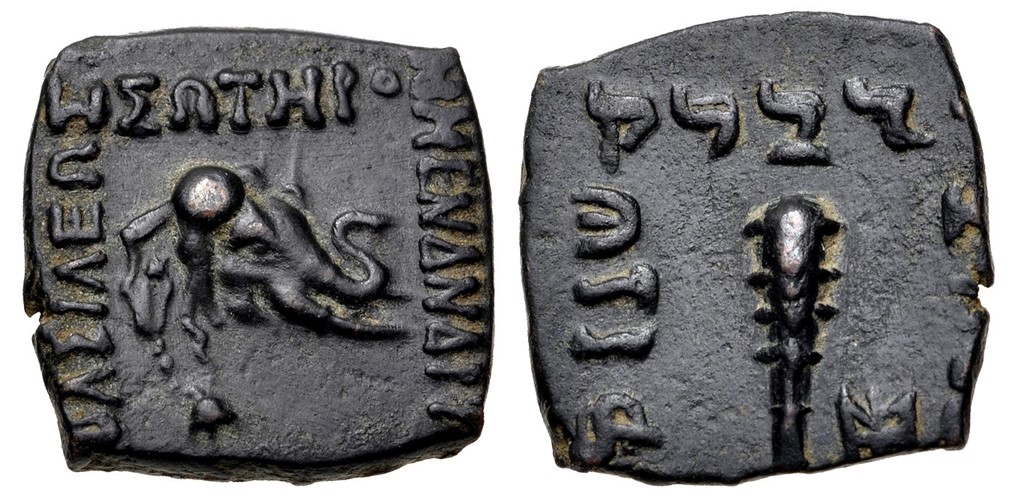 |
This base-metal coin was issued for the Bactrian king Menander I (c.165-130 B.C.). It shows the head of elephant adorned with a bell, opposite the club of Heracles. Menander ruled an area that included much of modern-day Pakistan and was a patron of Greco-Buddhism.
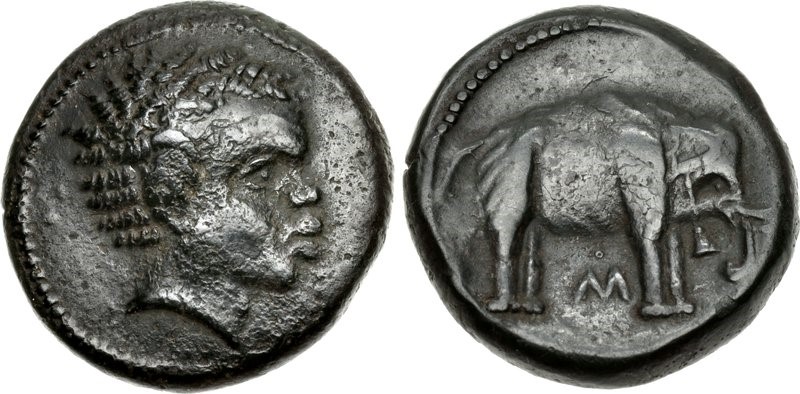 |
Knowledge of elephants spread far beyond their historical range. This base-metal coin was struck in Etruria in central Italy in the 3rd century B.C.
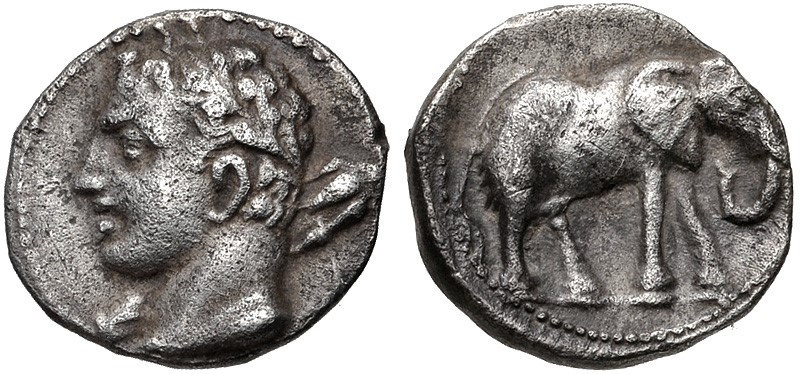 |
To the west of Italy, in Punic Spain, this silver quarter shekel of c.237-209 B.C. also shows an elephant. At the time, Carthage was asserting its influence in Spain under renowned general Hamilcar, who was well-versed in the use of war elephants. Hamilcar died in battle in 228 B.C., and his son Hannibal was named commander of the army seven years later at the age of 26.
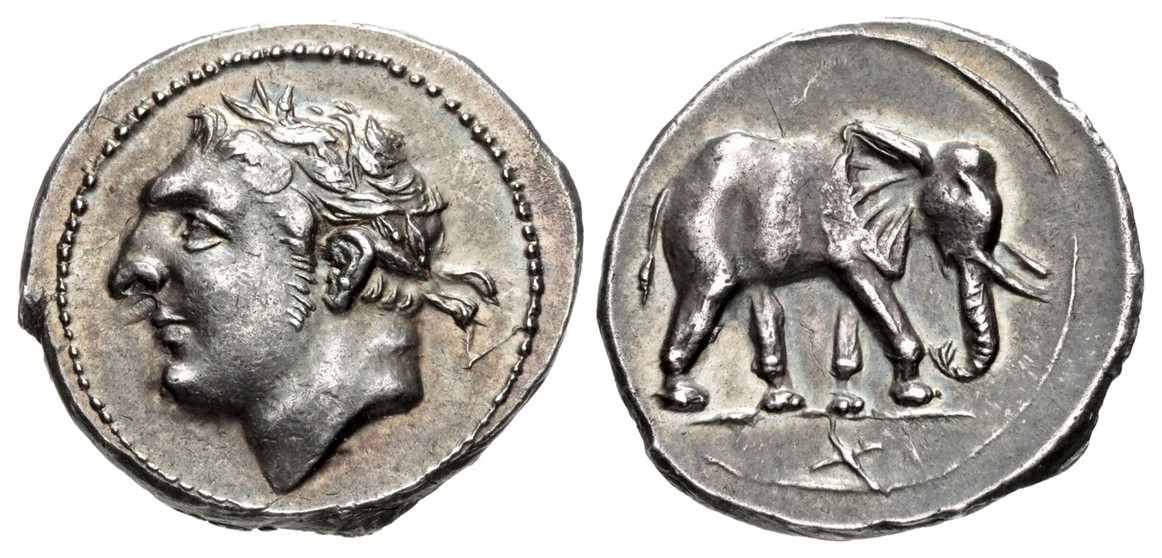 |
Seeking to avenge Carthage's loss of the First Punic War (264-241 B.C.) a generation earlier, Hannibal sparked the Second Punic War in 220 B.C. by besieging a Roman ally in Spain. It was during this conflict — called the Second Punic War (218-203 B.C.) — that Hannibal famously crossed the Alps to invade Italy with his army, which included war elephants, most of which died in the attempt.
This silver half shekel dating to that war shows the Punic god Melkart on the obverse and an elephant advancing on the reverse. The elephants used by the Carthaginians are thought to have been the North African elephant, a subspecies of the African bush elephant that died out in Roman times.
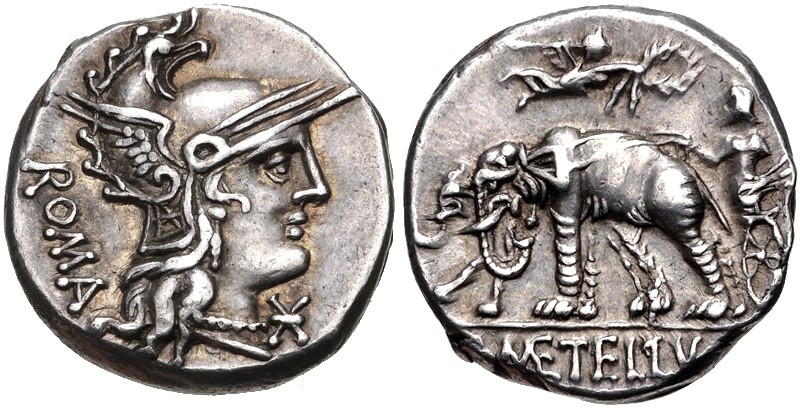 |
Rome's victory over Carthage in the Second and Third Punic Wars allowed it to dominate most of the Mediterranean by the time this silver denarius was struck in 125 B.C. Issued by C. Caecilius Metellus Caprarius, it shows Roma on the obverse and Victory crowning Jupiter, who drives a biga of elephants on the reverse.
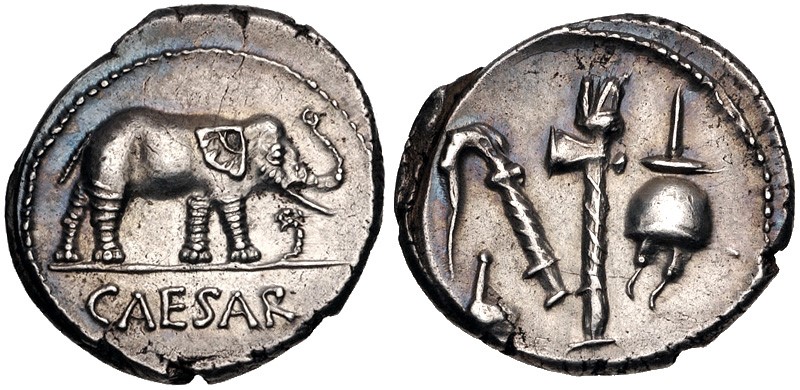 |
The most famous of all ‘elephant’ coins is the silver denarius of Julius Caesar (died 44 B.C.), which he issued in 49 or 48 B.C. at a military mint traveling with him. At the time, Caesar had just begun Caesar's civil war, in which he fought his rival, Pompey.
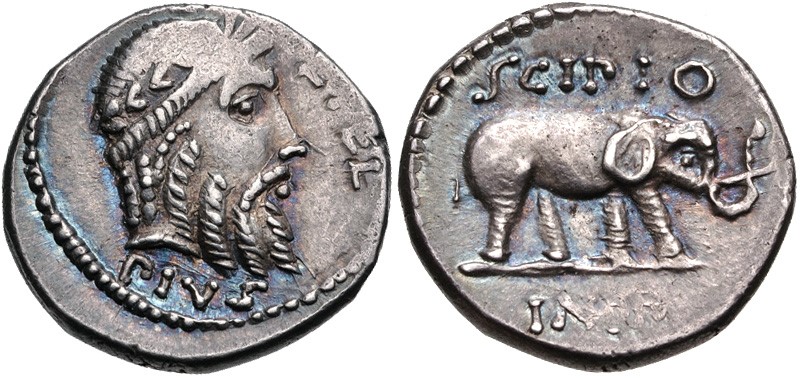 |
On the other side of the civil war, the Imperator Metellus Pius Scipio issued this silver denarius in 47-46 B.C. showing the head of Jupiter and an advancing elephant. To the Romans, these creatures were evocative of Africa, which Metellus Scipio used as his power base after the death of his ally Pompey in 48 B.C.
 |
This base-metal coin was issued ca. 60-46 B.C. by Juba I, king of the North African kingdom of Numidia, who fought on the Pompeian side during the civil war. Juba and Metellus Pius Scipio opposed Julius Caesar in North Africa but were on the losing side of the Battle of Thapsus in 46 B.C., the last large-scale use of war elephants in the West. Seeing their cause as hopeless, Juba and Metellus Scipio are both recorded as choosing honorable deaths a short time later.
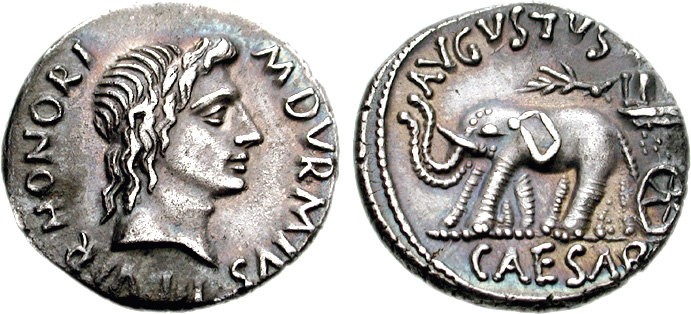 |
This silver denarius issued in 19 or 18 B.C. honors achievements in the East by Rome’s first emperor, Augustus (27 B.C.-A.D. 14). The reverse shows a biga of elephants driven by Augustus, who that year recovered the military standards that were lost at the Battle of Carrhae 34 years earlier.
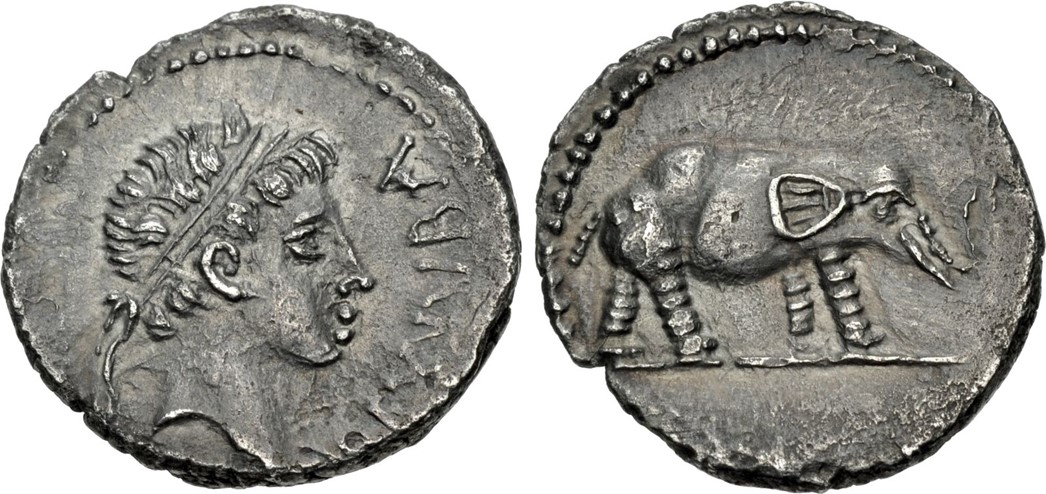 |
This silver denarius of Juba II (25 B.C.-A.D. 23/4), king of Mauretania, shows the king’s portrait opposite an elephant. Juba II was the son of the defeated Juba I and a childhood friend of Augustus, who in 25 B.C. rewarded him for his loyalty. With Roman support, Juba II ruled his kingdom for nearly half a century.
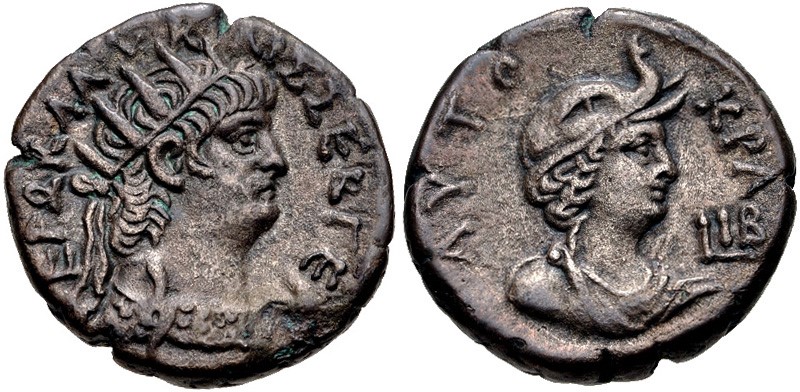 |
This billon tetradrachm struck in Egypt late in the reign of Emperor Nero (A.D. 54-68) shows a draped bust of a woman, representing the city of Alexandria, wearing an elephant headdress.
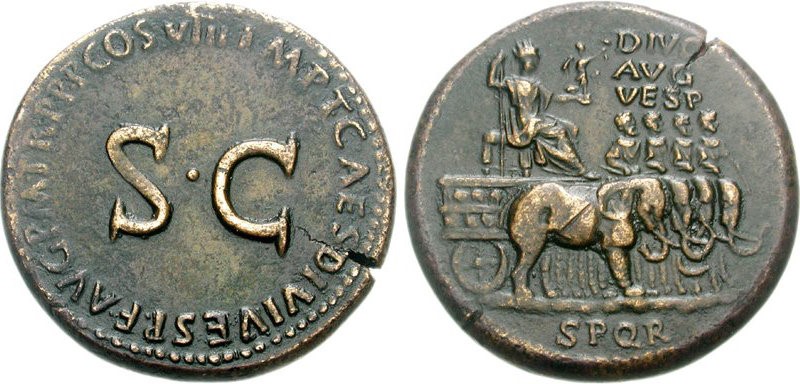 |
This base-metal sestertius produced soon after the death of Emperor Vespasian (A.D. 69-79) in A.D. 79 offers him a dignified send-off. It shows the deified emperor holding Victory while being drawn by a quadriga of elephants with riders.
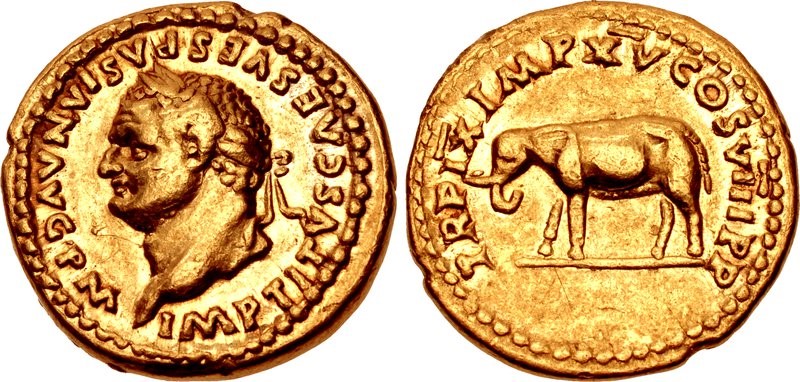 |
Vespasian's son and successor, the emperor Titus (A.D. 79-81), issued this gold aureus in A.D. 80, shortly after becoming emperor. The size and shape of the tusks appear to identify the elephant here as an African one.
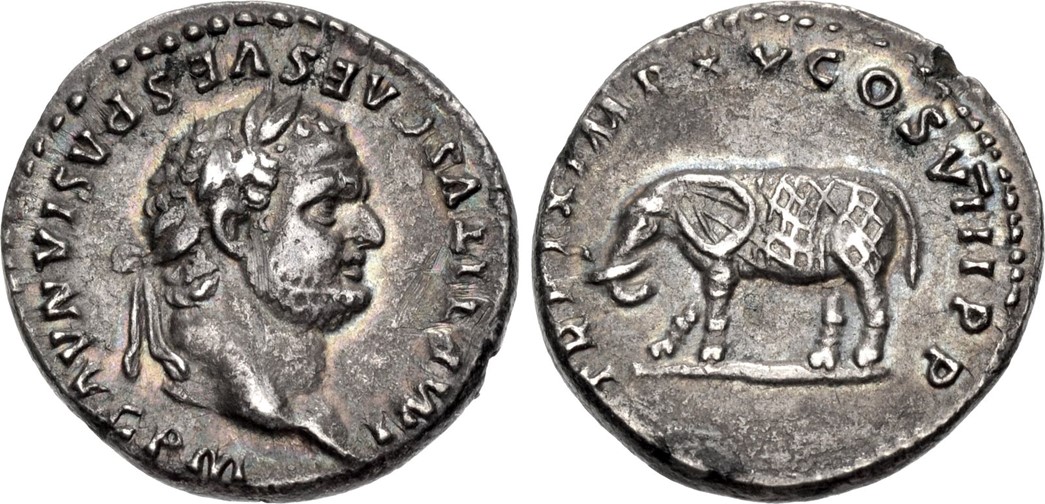 |
This silver denarius, from the same issue as the gold aureus above, shows an elephant wearing armor. At the time, Titus had just inaugurated the Colosseum with weeks of games, which included displays of elephants and many other creatures. A contemporary writer recounted a contest in which an elephant subdued a bull and then knelt before Titus.
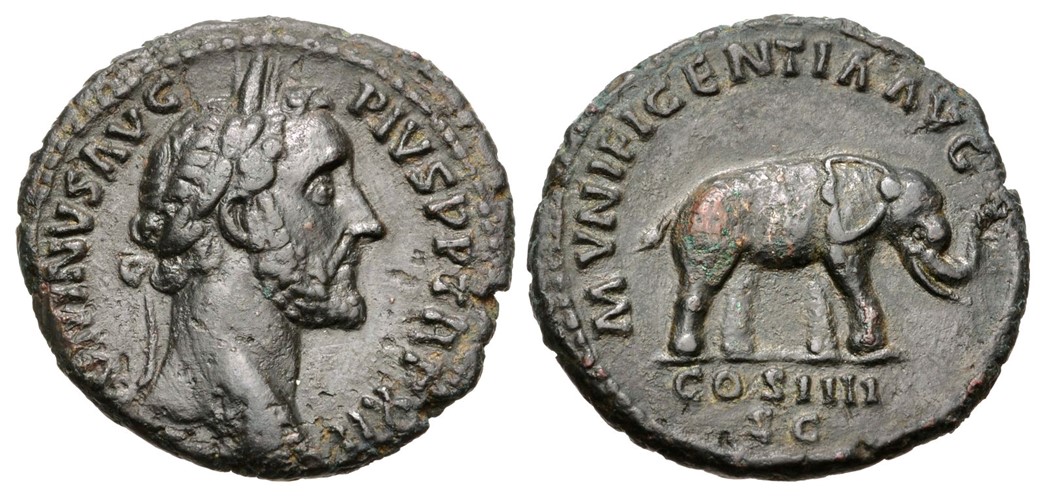 |
This base-metal "as" coin issued under Emperor Antoninus Pius (A.D. 138-161) shows an elephant. It is inscribed MVNIFICENTIA AVG COS III and was issued in celebration of games held for Rome’s 900th anniversary.
 |
Another coin struck under Antoninus Pius was this brass sestertius, issued shortly after the death of his wife, Faustina Senior, in A.D. 140/1. The legend on the obverse attests to her divine status, while the reverse shows her seated in a chariot drawn by elephants.
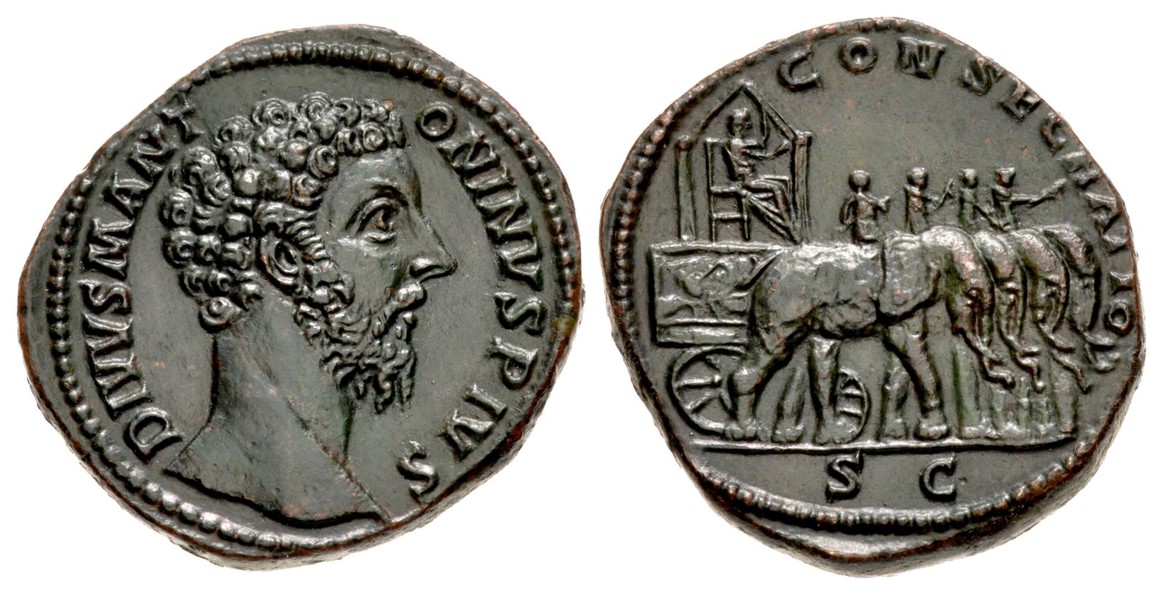 |
In a similar vein, elephants also are shown celebrating the divinely honored Emperor Marcus Aurelius (A.D. 161-180) on this base-metal sestertius issued shortly after his death.
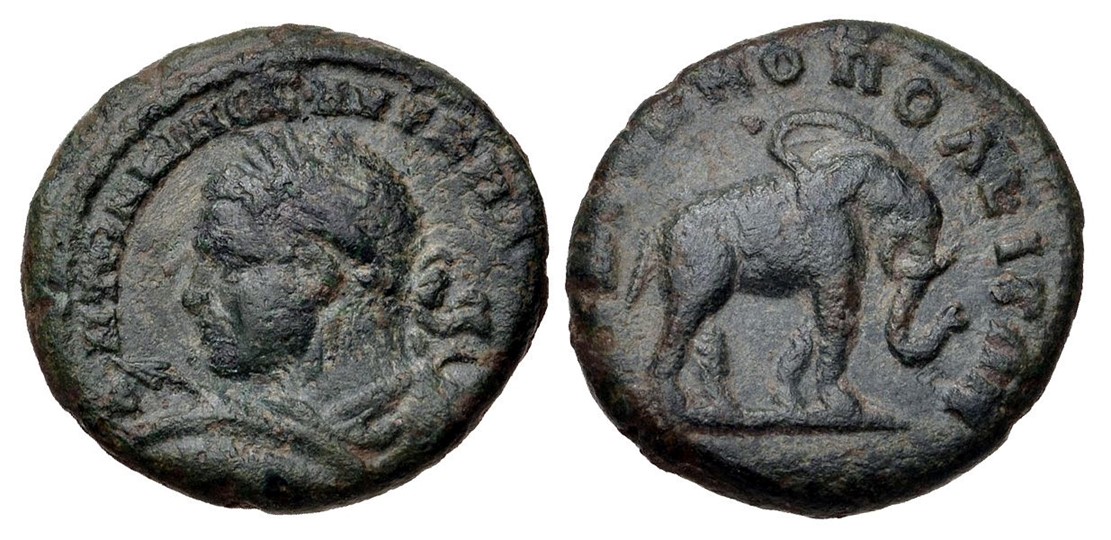 |
This intriguing base-metal coin depicting an elephant was issued in Hadrianopolis in Thrace under Emperor Caracalla (A.D. 198-217).
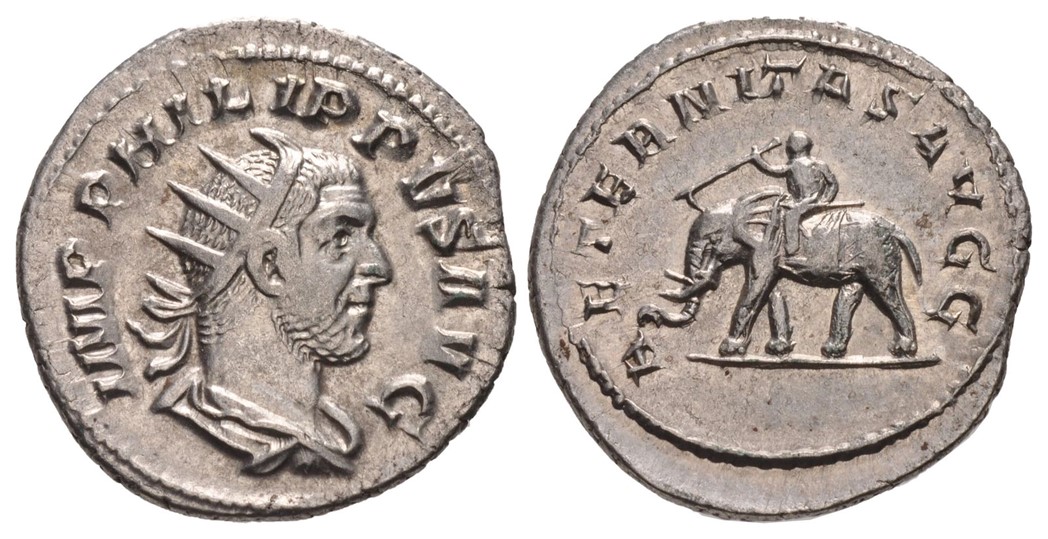 |
This silver double-denarius was issued under Philip I (A.D. 244-249) to celebrate the Ludi Saeculares during his reign, which marked the 1,000th anniversary of the founding of Rome.
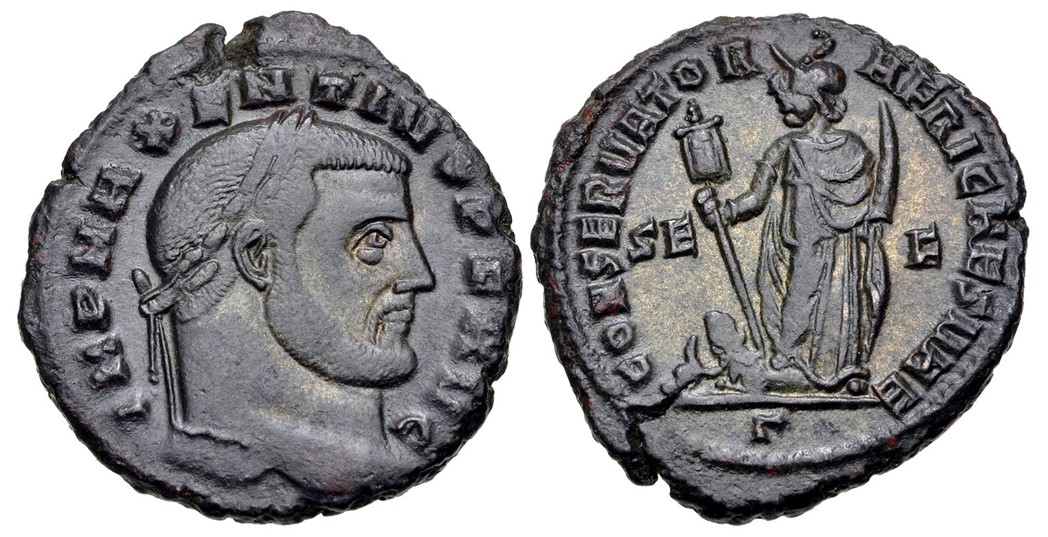 |
This billon nummus issued at the mint of Carthage for the rebel-emperor Maxentius (A.D. 307-312) shows the personification of Africa. The figure wears an elephant headdress and holds a tusk. The ivory of elephant tusks was highly valued in Roman times, and its attraction long outlasted antiquity. International ivory trade was finally banned in 1989 in an effort to prevent elephants from going extinct.
Images courtesy of Classical Numismatic Group
