Counterfeit Detection: Fake Redfield Hoard Holders
Posted on 8/12/2025
By
Paul Sandler
CCG Director of Client Success
The Redfield Hoard of silver dollars stands as one of the most legendary discoveries in American numismatics. Amassed starting in the 1930s by eccentric millionaire LaVere Redfield, the hoard contained more than 400,000 silver dollars by the time of his death in 1974. It was made up primarily of Morgan and Peace Dollars, which had been acquired from banks and coin dealers throughout his life.
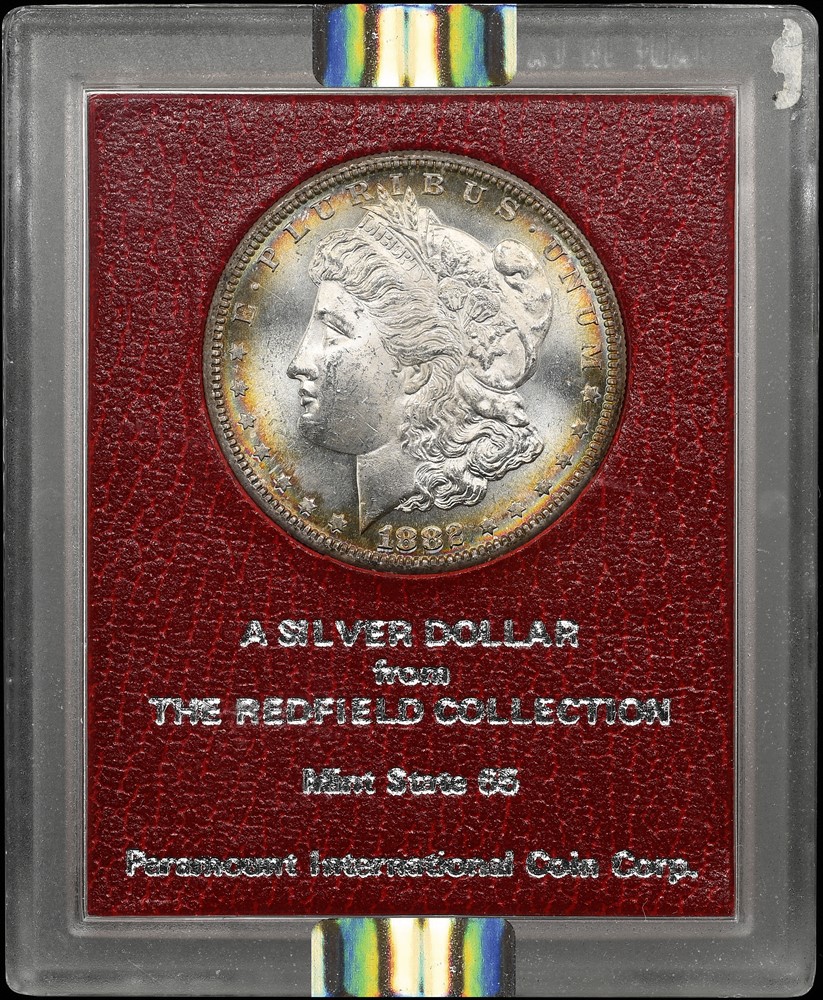
Redfield, who distrusted banks and paper currency, stored the coins in his Reno, Nevada, mansion, with the majority hidden behind a false wall in his basement. Following his death, the hoard was discovered and ultimately sold in 1976 to A-Mark Coin Company for $7.3 million. The coins were later marketed and sold individually, many in specially marked Paramount International Coin Corporation holders that bore the “Redfield” pedigree, like the one below.
 |
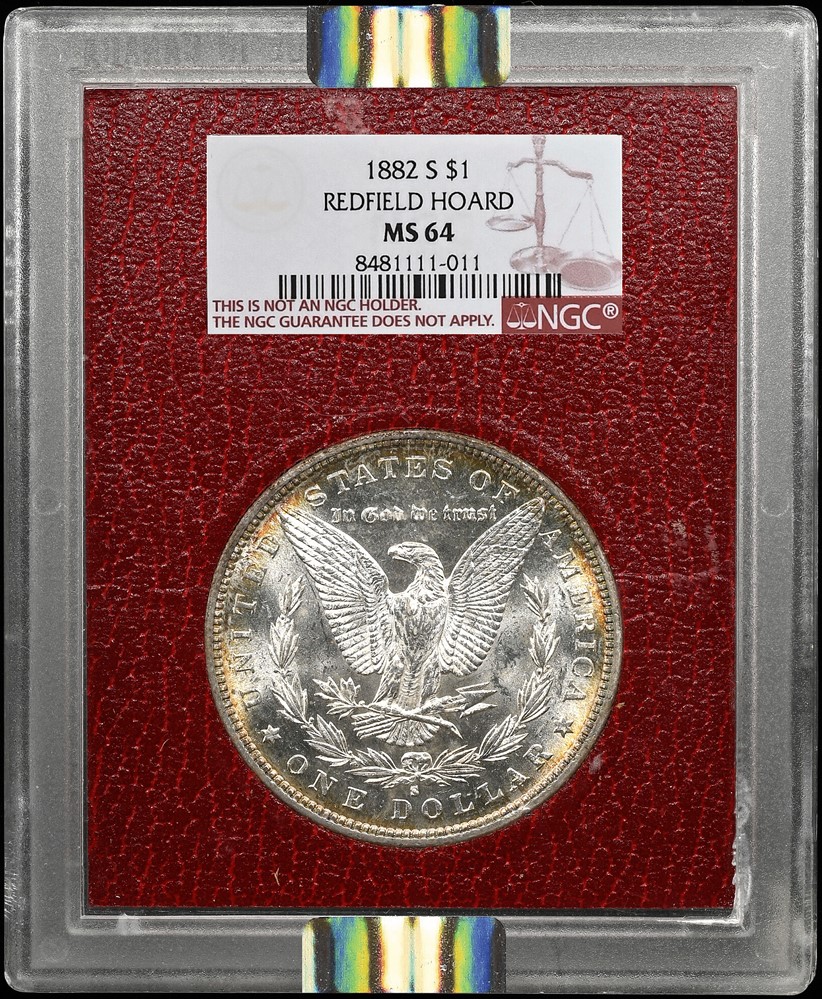 |
| an 1882-S Morgan Dollar in its original Redfield holder graded NGC MS 64 Click images to enlarge. |
|
The significance of the Redfield Hoard to the numismatic community extends beyond its sheer size. While many of the coins were common-date examples, a substantial number were in Mint State grades, preserved through decades of storage. The hoard also helped popularize the idea of pedigreed coins, where a coin's backstory or provenance adds collector appeal and, therefore, market value.
Today, coins from the Redfield Hoard remain highly desirable, valued both as historical artifacts and as tangible remnants of one of the most remarkable hoards in numismatic history. The Redfield pedigree commands a significant premium; for example, an 1881-S Morgan Dollar graded NGC MS 63, typically worth around $70, might sell for upwards of $300 in the same grade when housed in an original Redfield holder.
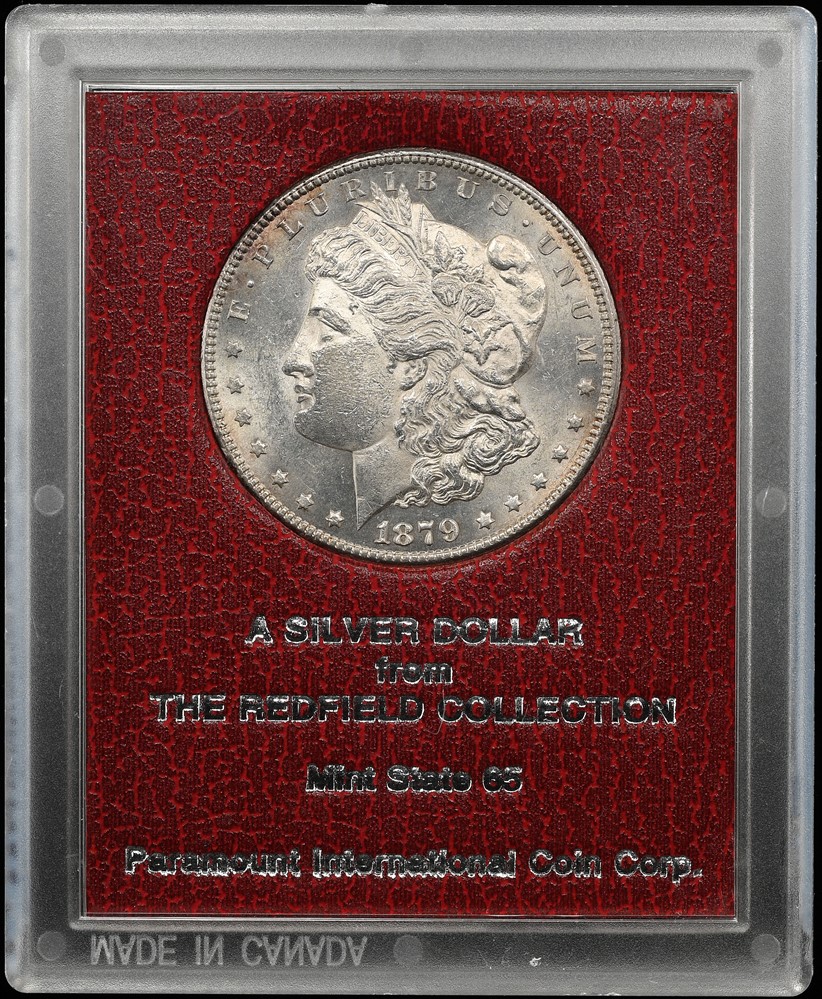
This substantial price disparity has unfortunately attracted the attention of counterfeiters. In certain instances, lower-grade coins have been removed from original Redfield holders and replaced with higher-grade or rare-date examples to mislead collectors. This practice is intended to inflate the coin’s perceived value by presenting it as a superior specimen in a Redfield holder, thereby commanding a significantly higher premium. More concerningly, a recent submission to NGC included nearly 30 counterfeit Redfield holders, one of which is pictured below.
 |
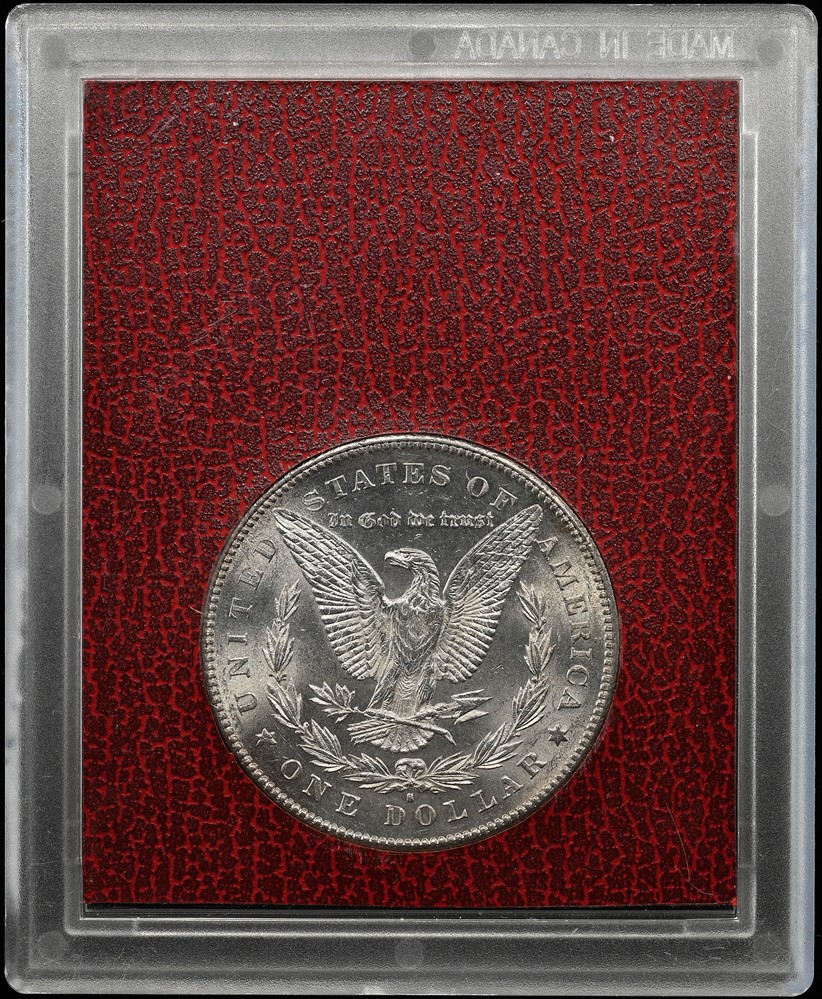 |
| Genuine 1879-S Reverse of 1878 Morgan Dollar in a counterfeit Redfield holder Click images to enlarge. |
|
There were numerous issues that stood out to the NGC grading team when they saw this coin in a recent submission. First off, the coin did not appear Uncirculated, which is a bit unusual for a coin in a red-cored Redfield holder. While most Redfield coins NGC grades do not meet the MS65 grade indicated on the red Redfield cores, they typically fall within the lower mint state range. The same submission also included previously unrecorded Redfield date and mintmark combinations, such as a lone 1902-P. However, upon closer inspection, it became clear that the primary issue lay with the holder itself.
 |
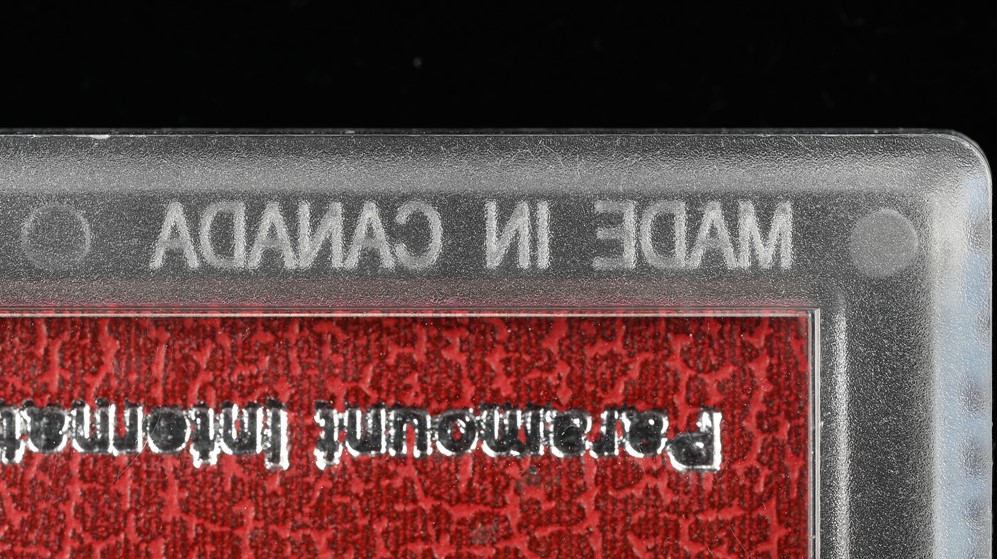 |
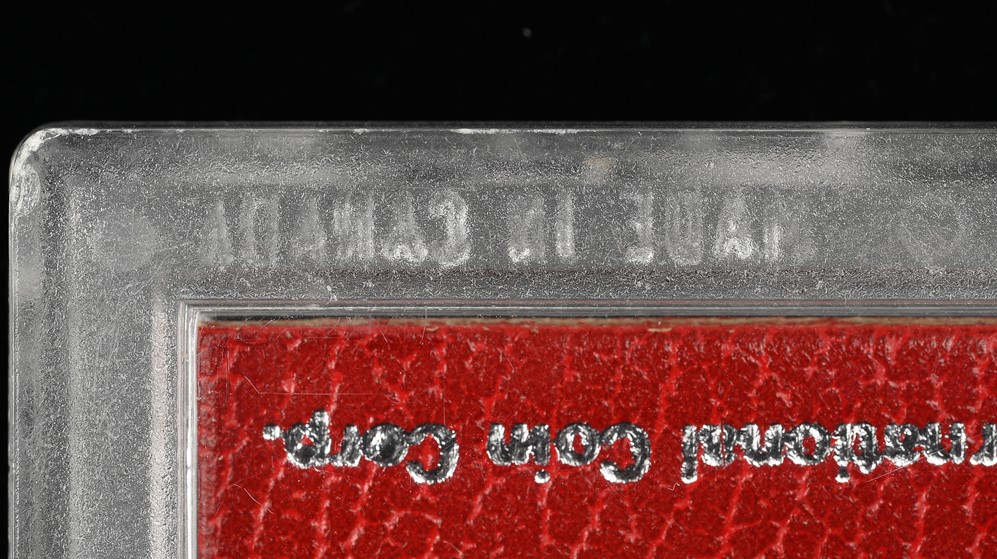
| Genuine Redfield holder (left) and counterfeit (right) Click images to enlarge. |
|
As shown in the photos above, the "MADE IN CANADA" marking on the interior of the holder appears significantly sharper and more prominent on the counterfeit example. Additionally, the red texture of the cardboard insert differs slightly in pattern and displays noticeably darker, almost black, surfaces. However, the most pronounced difference was observed under ultraviolet (UV) light.
 |
|
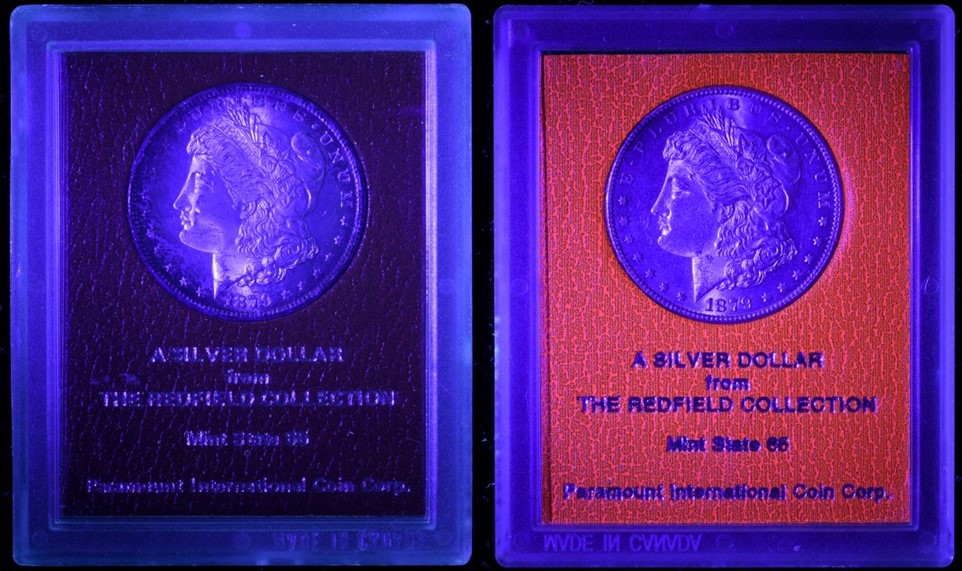
| Genuine Redfield holder (left) and counterfeit (right) under UV light Click image to enlarge | |
As clearly demonstrated in the photos above, the genuine core exhibits no reaction under ultraviolet (UV) light, while the counterfeit glows a vivid red. This indicates a significant difference in the materials used, confirming that the fake holders were constructed with non-original parts. While this evidence alone was sufficient to identify the holders as counterfeit and therefore ineligible for NGC grading, we sought even more concrete proof. Through further research, NGC was able to conclusively prove that the coin was placed in the holder in just the last few months.
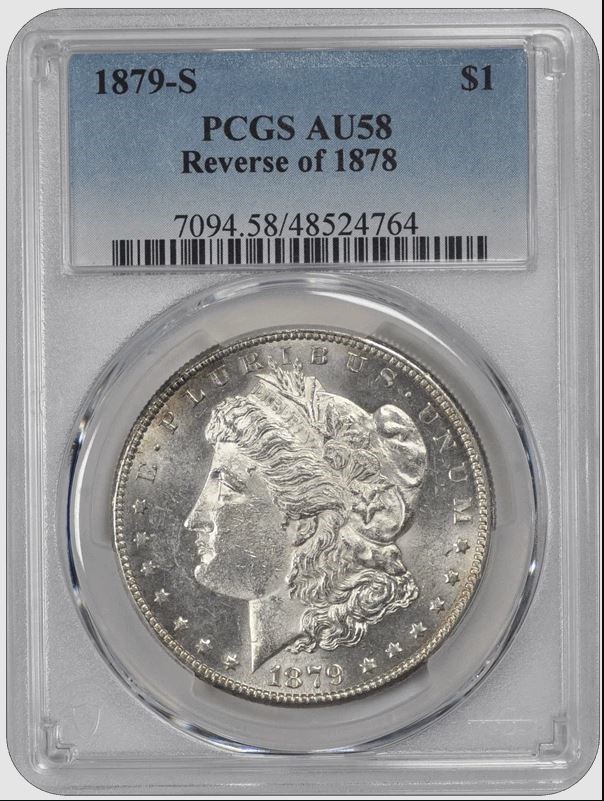 |
| 1879-S Reverse of 1878 Morgan Dollar in another grading service’s holder with a grade of AU 58(photo courtesy of eBay) Click images to enlarge |
The coin pictured above was listed for sale on eBay and marked as no longer available on May 13 of this year. Notably, it is the exact same coin that was subsequently submitted to NGC encased in a counterfeit Redfield holder, which further confirms the deliberate attempt to misrepresent its provenance.
 |
|
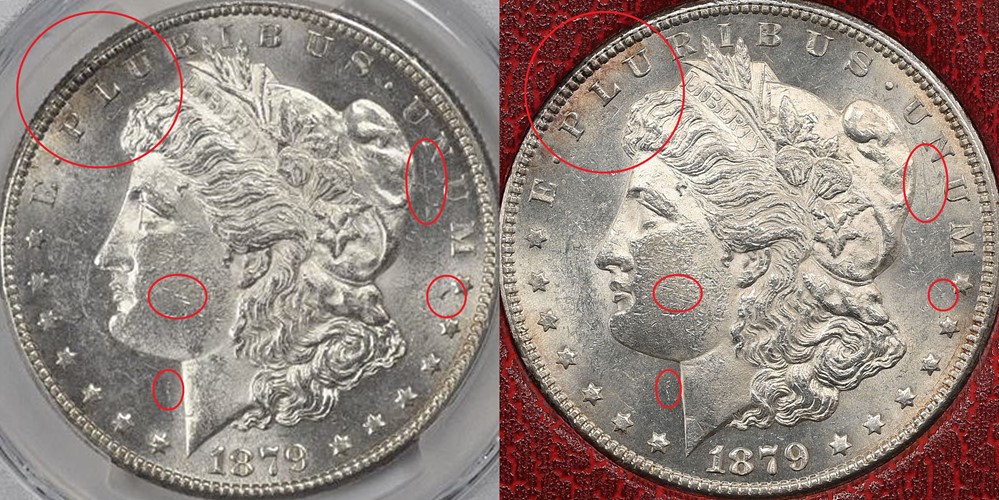
| Closeups of the 1879-S Reverse of 1878 Morgan Dollar Click image to enlarge | |
As shown in the photos above, the patch of toning through the "PLU" is identical on both coins. Additionally, the contact marks in the fields and on Liberty’s face align precisely. This shows that the forger likely acquired the coin in its original third-party grading service holder, removed it and placed it into a counterfeit Redfield holder to create the appearance of a collectible with significantly higher value.
Submitting your coins to NGC ensures they are evaluated by leading numismatic professionals using advanced authentication tools and techniques. As always, coins graded by NGC are guaranteed to be authentic and properly graded.
Did you know? NGC has created a comprehensive Counterfeit Detection resource to help collectors and dealers identify counterfeit and altered coins. Visit NGCcoin.com/counterfeit.
