Jim Bisognani: Are Prooflike Sets from Canada Undervalued?
Posted on 6/26/2025
 |
 |
Late June has brought some truly sizzling weather to many parts of the country. Today, as I type away in my home sector, it is a bright sunny day. We topped out at 101 degrees Fahrenheit at midday! Triple digits in New Hampshire are a rarity. Surprisingly, I did enjoy walking around the yard and soaking in the tropical, jungle-like conditions.
Ahh, the memories of my youth came rushing back to me. Those hot, hazy and humid days of summer vacation, family barbecues, strolling on the hot sand and dipping my scorched feet into the icy ocean waters at Wallis Sands Beach. And the song made famous by Nat King Cole... Well, I just can't shake away the happy lyrics of "Those Lazy, Hazy, Crazy Days of Summer" from my head.
It was mid-June, during the early stages of summer vacation those many, many moons ago, when I encountered my first "foreign" coin. I remember receiving it in change after I had bought an orange Popsicle. It was a nickel with a beaver on the reverse! “What's this,” I thought, “Where is the Monticello?” On the obverse, there was a rather nice-looking lady, not Thomas Jefferson. I was certainly befuddled and thought, perhaps, that I had found something truly rare. No, this foreign coin was from our neighbor to the north: Canada.
Since the Canadian border was a mere few hundred miles from my hometown, it wasn't an unusual occurrence to find Canadian coins infiltrating our change. Though there was an exchange rate difference, most of the time local merchants would take a small number of these "foreign" coins on par with their US counterparts.
So when I could, I would set aside the occasional dime with the ship The Bluenose on it, and quarters with the proud Caribou's profile.
Soon, I was noticing the different portraits of that lady — Queen Elizabeth II — on the obverse. The so-called young head designed by Mary Gillick, which donned the Canadian coins from 1953 to 1964, were followed by the youthful head donning a tiara designed by Arnold Machin starting in 1965.
Like millions of others around the world, I was consumed by a feeling of loss and sorrow in the days following Her Majesty's death on September 8, 2022, at the age of 96. Initially, I couldn't figure out why. I had never met Her Royal Majesty, nor was I a subject or resident of the UK or any other Commonwealth country. Yet, I felt as though I had known her my entire life. Then, of course, the realization hit: I have been collecting coins with Queen Elizabeth's effigy nearly all my life!
Although Queen Elizabeth took the throne upon her father George VI's death on February 6, 1952, Elizabeth's coronation wasn't until June 2, 1953 — over a year later. 1953 marks the first year for which coins bearing Her Highnesses 26-year-old effigy and name were struck for general circulation in several Commonwealth countries outside of the UK.
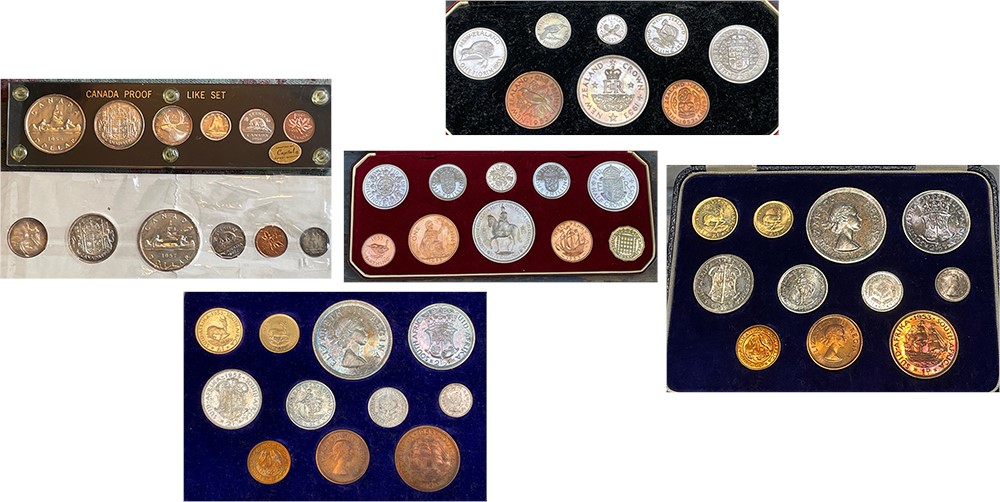
Through the years, I have collected coins of Queen Elizabeth's coronation year (1953). The demand for those inaugural Queen Elizabeth II coins certainly accelerated after her death. Of course, with increased demand, prices for high-grade Proof coins rose exponentially. Although several "VIP" Proof format coins of various issuing nations were struck "informally," only three countries actually produced Proof sets for the coronation year of 1953 — Great Britain, New Zealand and South Africa. Yet, our neighbor to the north, Canada, introduced a new innovation for the coronation.
1953 marks the first year that the Ottawa Mint would produce the inaugural and very popular "Uncirculated" year sets. Though not presentation strikings, the coins were obviously struck with care and were a few steps above those minted for general circulation. These were later dubbed with the moniker "Prooflike" sets. Regardless of name, these were struck in very limited quantities and the coins from cent to dollar were secured in white cardboard holders and wrapped in cellophane. Total production for the 1953 set was limited to 1,200, which places this set at the lowest mintage of any of the coronation year issues.
At present, I own the Great Britain (mintage: 40,000), New Zealand (mintage: 7,000) and South Africa 11-piece set with gold coins (mintage 3,000) Proof sets. However, it is the scarce 1953 Canada Prooflike set that I have not yet secured for my own collection.
 |
Actually, to me, there is a considerable value in all of the Canadian sets produced in the 1950s. My fellow coindexters, consider the following mintages of these, compared to our own US Proof sets of the time:
| Mintage | USProof Set | Mintage | |
|---|---|---|---|
Now, I am not suggesting that the Canadian Prooflike sets are as popular as the US counterparts. However, the mintages — especially for the 1953-56 Canadian sets — are very low, putting them on par with the 1936 (mintage: 4,130), 1937 (mintage: 5,756) and 1938 (mintage: 8,728) US Proof sets. In the case of the 1953 Canadian issue, that mintage of 1,200 puts the coronation issue in more elite company, similar to mintages enjoyed by Barber coinage, Liberty Nickels and Indian Cents at the turn of the 20th century.
 |
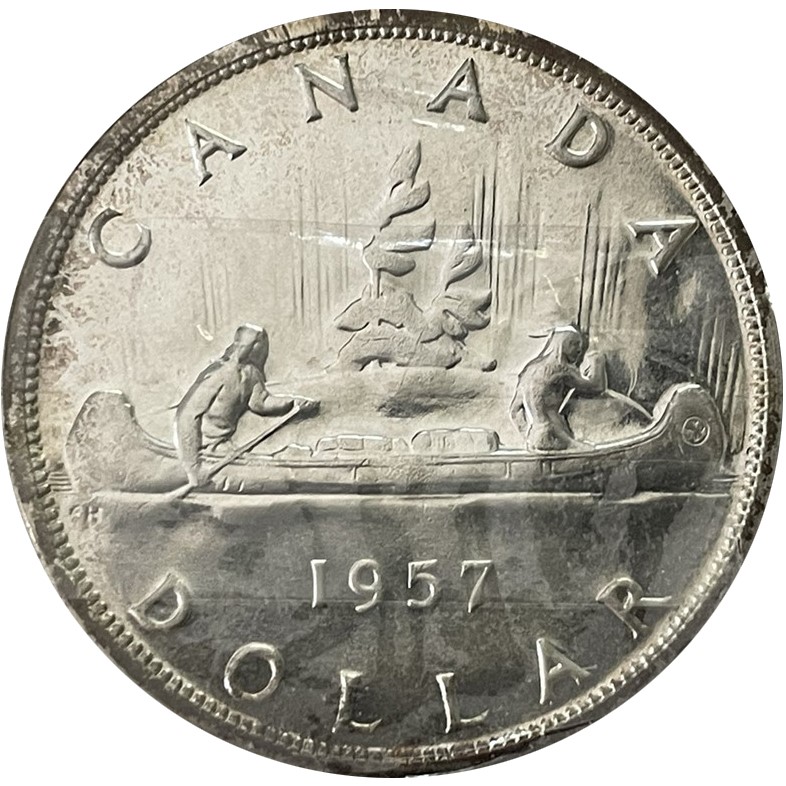 |
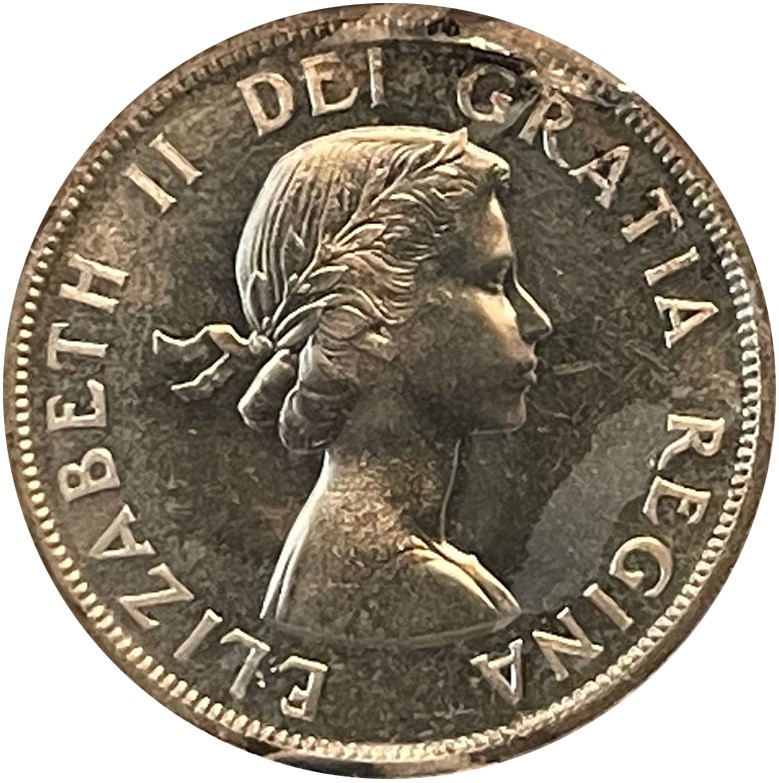
| Jim's Canada 1957 "Prooflike" Silver Dollar Click images to enlarge. |
|
At present, the inaugural 1953 set is being offered in original cellophane wrap at between $1,200 and $1,500, which I believe is a very good value, especially considering the low production and overall popularity of collecting Commonwealth coinage of our northern neighbor. Perhaps an even better value are the 1954-56 sets — here, you can still find nice original 1954 Prooflike sets around $400, and the 1955-56 Prooflike sets in the mid-$200 range! Now, back to that term "Prooflike," as it pertains to the Canadian sets...
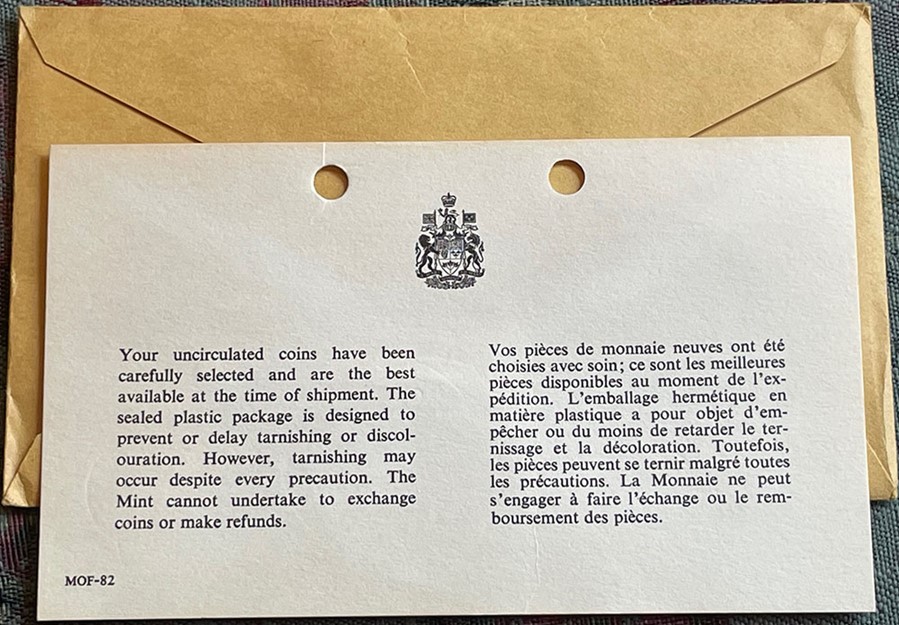
It is interesting to note that the Royal Canadian Mint has never used the terminology "Prooflike" in conjunction with the prized silver issues from 1953 to 1967. This is evident by the simple cardboard insert tucked inside the manila shipping envelope included in those sets from 1960 onward.
 |
|
Click image to enlarge. |
|
As a learned coindexter on one of the NGC Chat Boards explained:
"As far as the RCM was (and is) concerned, all of the sets from 1953 to the present are simply uncirculated mint sets. The term Proof Like was utilized by collectors and dealers to describe the sets as the coins in them were often a cut above the coins released into the channels of circulation, showing evidence of different techniques in their manufacture and more care in their handling. So, if the proper Royal Canadian Mint terminology is to be used, coins from these sets should all be considered uncirculated set strikes, as that is what the Royal Canadian Mint calls them all."
Wow, it cooled down today — we only topped 90 degrees Fahrenheit here in New Hampshire. Newsworthy world events — the chaos and war in the Middle East and the US airstrikes in Iran — have had surprisingly little or no impact on the price of gold. Instead, the yellow metal is holding firm in the $3,300+ range. Silver has also remained steady, yet it's now moving closer to new highs.
However, the strongest of the metal contingent has been platinum. Over the last month, the rare and strategic metal has accelerated by over 35%. Though Platinum isn't as exciting as gold for most coindexters, perhaps adding a few Platinum Eagles would be a wise and timely move. Gold coins, of course, are still a mainstay and are being gobbled up by collectors and investors. Yet, the days of the $20 Libs and Saints being "collector" coins as they had built-in cushion from their numismatic value component have passed for the common-dated pieces.
The following message posted on one of the electronic trading networks sums it up:
"20 PCGS/NGC Gold Pieces... MS 62 Libs and MS 63 Saints. Sell MS 62 $20 Libs at melt + $15 and MS 63 $20 Saints at melt + $25"
Another said:
"Offering up to 21 NGC MS 62 $20 Libs at $3,235 each." (At the time of the message, this was $20 over melt value.)
And then there was this message for $10 Libs:
"Offer up to 33 NGC MS 61 $10 Libs at melt. Nice mix of dates!"
That is correct, my friends: certified $10 Libs and Saint Double Eagles can now be purchased for less of a spread than the common US Gold Eagles — which, at present, are being sold at spot plus about $50. And if you are in a line for a new 2025 1-ounce US Gold Eagle, they're being offered up at spot + 3.5%, which would equal around $116 over melt, at the time of writing this.
Ah, the precious and joyful month of June is all but over. So, as I continue to roast and wax nostalgic, please enjoy our great hobby this summer, my fellow coindexters.
Until next time, be safe and happy collecting!
P.S.: The most important day in June is the 8th. That's Beth's and my anniversary!
Want to see more articles like this? Subscribe to the free NGC Weekly Market Report.
