Jim Bisognani: Coins Have a Bright Future
Posted on 5/29/2025
 |
It just hit me. That intangible force that guides us — time — is moving way too fast! I mean, we just enjoyed the Memorial Day holiday, and June is only a few days away. How can 2025 be nearly halfway over already? I need to pull out a stopwatch and set up some timelapse photography. There has to be some sort of an increased acceleration factor targeting us as we get older.
Ah! I see some of you nodding as you take a swig of prune juice. If you are in agreement out there in Coindexterland, please raise your hands so I can get a count!
OK, it's time to move on. We're just getting older, period.
Coins — their story and my adventures with those treasured metal discs — are now a 60-year-old affair. I truly became interested in coins in the summer of 1965, and not just as a means to buy something. Truth be told, the latent stimulus for my numismatic journey was an 1891-O Morgan Dollar that was placed in my Christmas stocking in 1964, but close enough.
 |
 |
| The 1891-O Morgan Dollar from Christmas 1964 Click images to enlarge. |
|
It has been a magical run, as just a year into my junior coindexter apprenticeship I was front and center in the "hunt for the blurry 1955" Lincoln Cent in the sweltering heat and humidity on our home staircase in July of 1966. (You can read more about those fabulous exploits here.) I didn't have the finances to quell all of my numismatic cravings (who does?), so I settled for the next best thing. Usually, by the end of May, I was busy sending self-addressed stamped envelopes for my favorite dealers' fixed-price lists and catalogs. Then, around mid-June, the postman would start delivering a steady supply of printed material to my door for me to devour.
Researching and understanding the history of those treasured metal discs was as much fun as acquiring them! Well, almost. Whether my current fixation was for a US type coin or a foreign commemorative, I wanted to know about the designer, the mintage, the current market value and — if the coin was in my budget — where to find one.
Back in the dark days of the abacus, nearly all of my school friends had some interest in coins. Most were collecting Indian or Lincoln Cents, Buffalo Nickels, etc. Many of these friends were male, but I recall Pam W., who had a fondness for Mercury Dimes. There was a lot of coin talk after school, with trades being offered and new acquisitions being bragged about. The local monthly coin shows that I attended were exciting, busy and the attendees were always a ripe mixture of young and old.
That demographic has certainly changed since my youth. While the numismatic market is still brisk, the issue, as I see it, is that the majority of numismatists today are male and probably approaching — or are indeed — senior citizens. I see a flurry of hands raised as you chase down your raisin bran with another swig of prune juice.
Of course, some of us still eat, drink and sleep numismatics as if it were a bowl of Wheaties. I can raise my hand on that point!
Yes, we coindexters are diehards about the hobby. I mean, I just got an email from a true blue fellow coindexter that read, "Hi, Jim! I am recently back from an extended trip to the United Kingdom with my family, where the 5-hour time difference 'forced' me to leave absentee bids. I just couldn't stay awake that late to bid live!"
Truthfully, it is our job to nurture, inspire and educate the younger numismatists. So please, after another gulp of prune juice, consider taking a young coindexter under your wing and point them to the wealth of online resources.
In several ways, today's collectors have so much of the framework laid out for them. Dealers have massive websites showcasing their wares. Some type of live online coin auction is held nearly every day. And if that weren't sufficient enough, we have this thing called eBay — the 24-hour coin store! For those concerned about getting the right grade, there is this service called third-party grading provided by NGC. NGC also supplies collectors with a wealth of information (free of charge!), including comprehensive price guides, auction data and census reports.
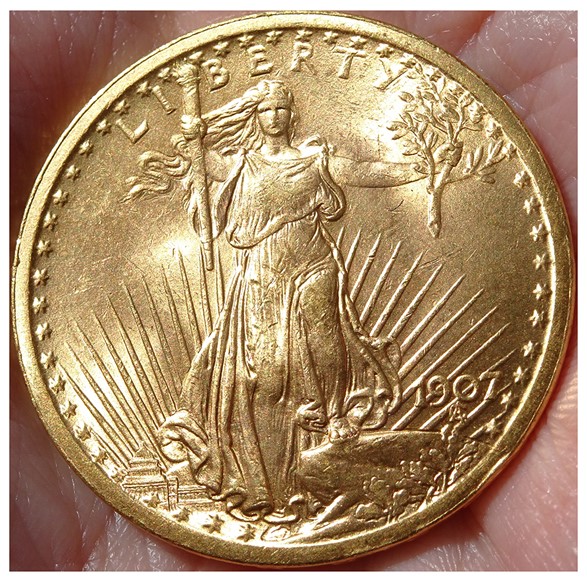
Today, numismatics is truly a different animal than it was a generation ago. While gold coins were never "cheap," per se, they were still very affordable. It was easy on the pocketbook for the average collector to acquire a gold Quarter Eagle or Half Eagle and add it to their collection. If you so desired, you could even pick up the most beautiful US gold coin: The Saint-Gaudens Double Eagle! Back in the day (1972 to be exact) I had saved up for my first $20 Saint-Gaudens. For the princely sum of $77, I was able to take home my beautiful 1907 Double Eagle. I purchased her when I was 15 years old (and yes, I still have that coin).
 |
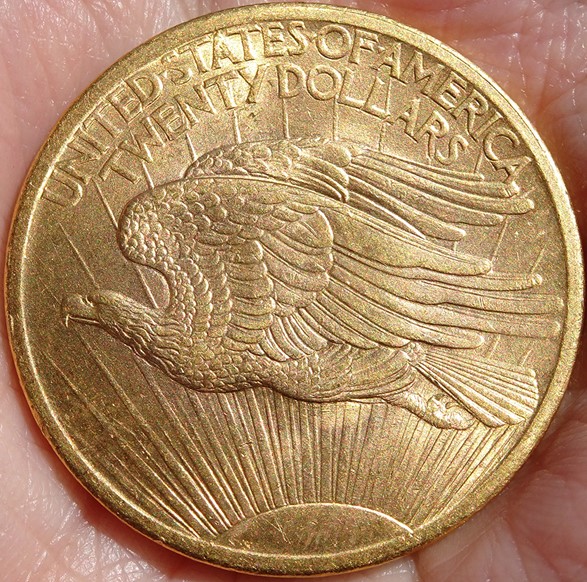 |
| Jim's 1907 Saint-Gaudens Double Eagle Click images to enlarge. |
|
Yet, if we flash forward to 2025, the mere purchase of a solitary US $5 Liberty or Indian Head type coin in BU condition is a significant purchase that could put strains on a family budget. If you're wanting a nice Gem $20 Saint-Gaudens for your type set, it's going to require an outlay north of $3,500 for one graded NGC MS 65!
Say you go easy and get a lesser MS grade. Get this: The price difference between an MS 62 to MS 64 $20 Saint-Gaudens is only $55. That's correct — a major trader is listing a $20 Saint-Gaudens graded MS 62 at $3,265, an MS 63 at $3,285 and an MS 64 at $3,320. It's truly an investment, not only financially but in time and education.
Either way, the term "investment" comes up more often in general conversation. This is because, if you're buying just a few gold coins, it's a significant investment. We aren't talking about a few hundred dollars for a pair of MS 65 Morgan Dollars here. In the case of gold coins, we're talking about thousands of dollars! The truth is, the average citizen just doesn't have thousands of dollars to spend on their hobby.
However, if you have a fixation and are just itching to buy some gold coins, the spreads are very, very favorable for the buyer.
Yet, for the average coindexter, my recommendations would be to hold off on gold coins right now and stick to some of the base metals. Even some silver, key date, low census coins make a lot of sense in this market. A simple adage for you: "If you take care of your collection, it will take care of you." Meaning: Put time and effort into your hobby and you will be rewarded financially down the road. I can't think of any instance where this has not been the case.
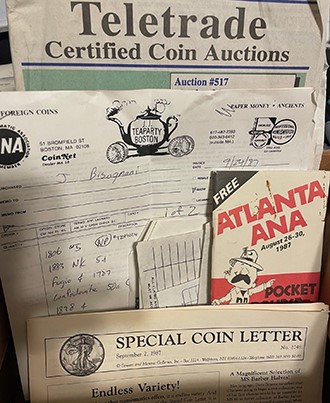
Just recently, I came upon an old duffel bag which was filled with some of my earliest dealer transactions. The first group I compiled were 38 years old. I was still a collector, but also on a buying trip for a few friends/collectors who wanted some "investment" coins. It was fascinating, reviewing invoices of coins I purchased at the first Long Beach Expo I attended in September 1987!
 |
Overall, I must admit — I wish I was still in possession of all the coins I purchased at that show.
Now, mind you, this was nearly 38 years ago. Yet, the invoices (at least, the ones I could find) totaled over $52,000. As this was the dawn of third-party grading, I only found four certified coins out of the hundreds I bought at the show. However, I know that most of the coins were subsequently submitted to NGC and other third-party grading companies for certification. That said, I would estimate that the current market value for this group would exceed $450,000!
This trio, of which I still have the inserts from the vinyl flips, cost me $7,100.
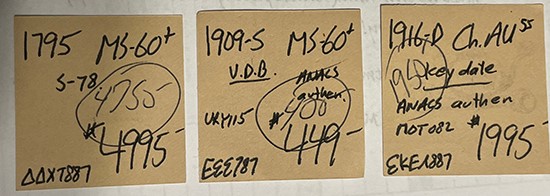 |
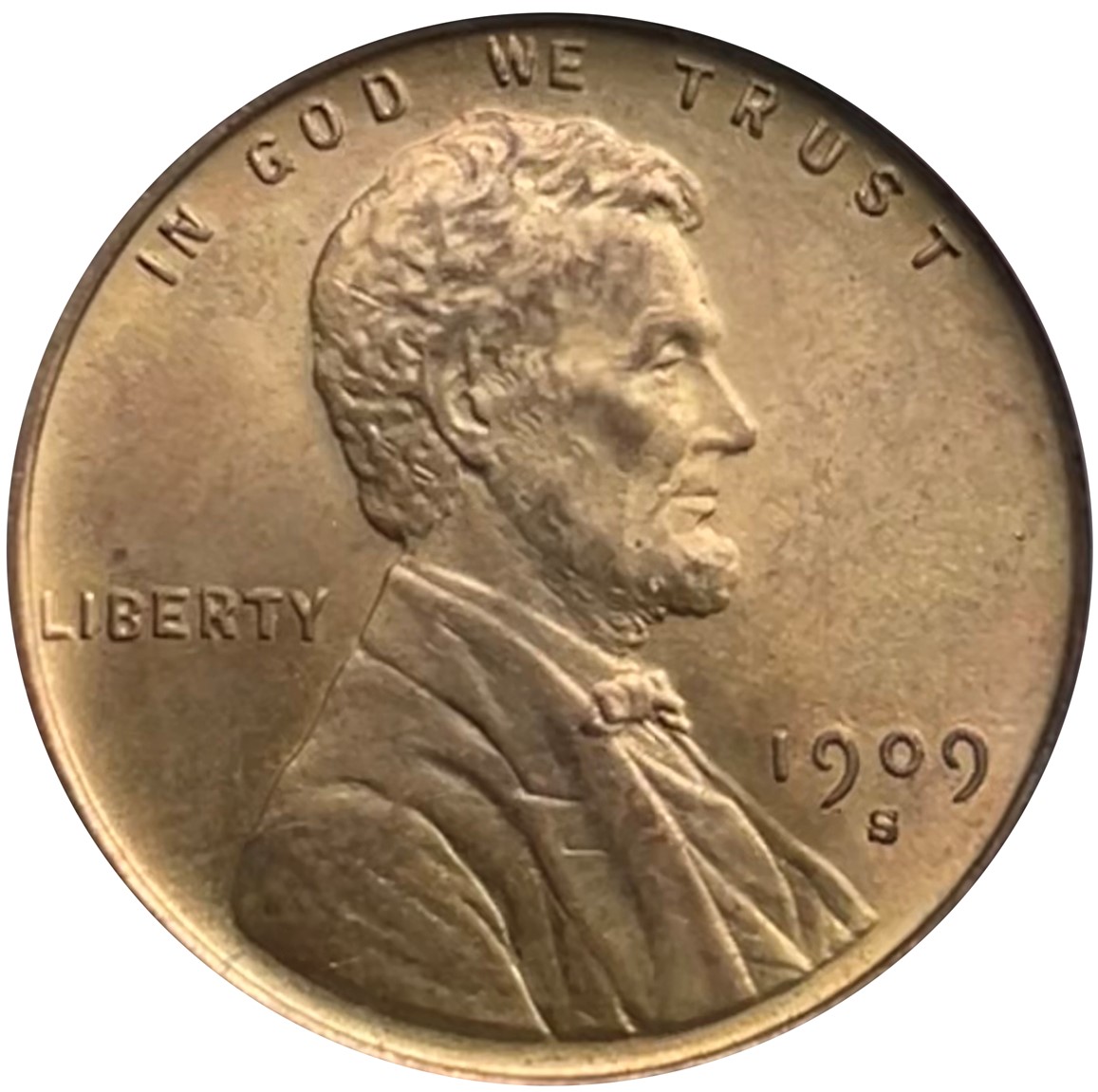
Of this group, I still have the 1909-S VDB, which at the time was rather conservatively graded as a 60+ and had an old ANACS photo grade attached, asserting it as an MS 63. It was $400. Well, it did make it into a third-party holder with a grade of MS 64 RB. Hey, that's a great looking coin! As of publishing this article, its current market value is $3,750.
 |
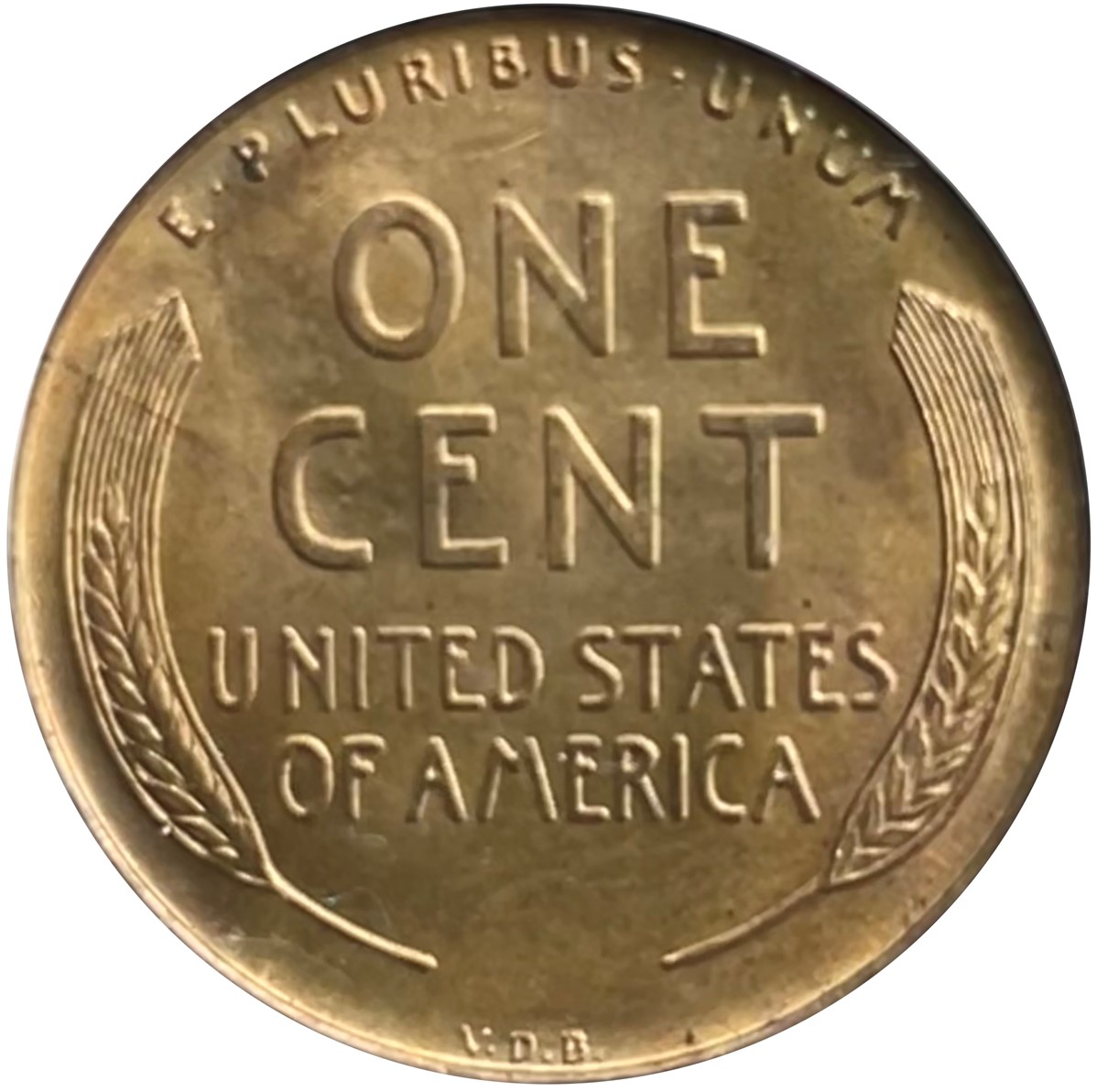 |
| Jim's 1909-S VDB Lincoln Cent Click images to enlarge. |
|
The 1916-D Mercury Dime was a phenomenal-looking coin, graded again rather conservatively as Choice AU 55. I am not sure if it made it into a third-party holder; if it did, it has to be an MS 62 or better. The key to the Mercury Dime series possessed just a wonderful eye-appealing natural look. Certainly it's a premium coin that I would easily value at $22,000.
The 1795 Large Cent Plain Edge S-78 was a superb example, with ample red surrounding a dark chocolate center. It was very conservatively graded as an MS 60+. Unfortunately, I have no idea of its whereabouts. The cost in 1987 was $4,750. All I know is that I sold the coin for the owner at the ANA in Pittsburgh in 1989 for $9,000! Today, I would estimate the coin's value to be at least $50,000.
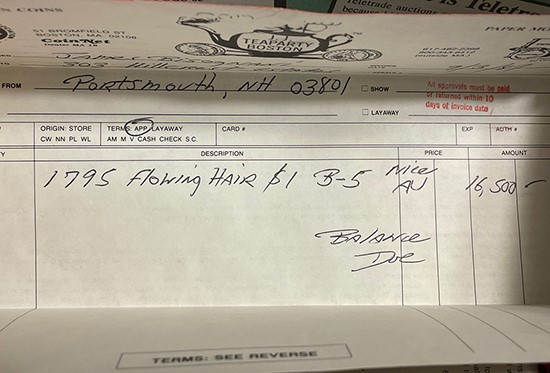
Then — my personal favorite of the group — a superb 1795 Flowing Hair Dollar with 3 Leaves B-5 graded as a Choice AU+ for $16,500. It, too, made it into a third-party holder as an MS 62. I don't know where she is today, but methinks she is probably in an MS 63 or even better TPG home. Regardless, I would say it's easily a $100,000 coin today.
 |
So, just this quartet in the fall of 1987 cost me $23,600. Based on my estimates and first-hand knowledge, I would value that group at $175,750 today, equal to a 645% increase in value.
Now that said, nice Mint State $20 Saints and Libs in 1987 were trading around $700 per coin. So let's say I bought $52,000 worth of raw, common-date $20 Saints and Libs at MS 63 to MS 65. That would equate to 74 Double Eagles. I'll be generous and assume that they all graded MS 65 — that would make the group worth around $259,000 in the current market, which is a substantial increase of 398%. Certainly a nice return, yet all the coins I picked out would have fared much better to the tune of a powerful 765% return!
Now, again, all of this is history. What happens in the future will be measured by many factors out of our own personal control. The bottom line is, if you take time to curate and build a collection, you'll not only have a significant numismatic portfolio, but will also have yourself and your heirs a great investment for the future.
Until next time, be safe and happy collecting!
Want to see more articles like this? Subscribe to the free NGC Weekly Market Report.
