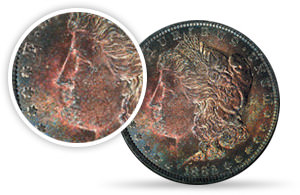

Artificial toning can be extremely difficult to detect, and
even harder to explain once discovered. Perhaps the best
explanation is that it just does not appear natural. |
 |
The composition of a coin is key in determining its
color. Each coin’s alloy reacts to atmospheric conditions in a different way and is a factor in the development of patina (toning). As an example, copper and
silver coins are more susceptible to toning than gold
coins are. Since most US coins are made of alloys
containing copper, most will tone.
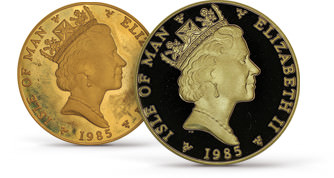
The term ARTIFICIAL TONING refers to the process whereby patina is imparted to a coin in an accelerated reaction process using chemicals and/or heat.
In many cases the purpose is to hide a defect that
would otherwise be detected.
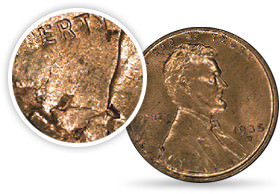
ARTIFICIAL COLOR refers to bronze, copper nickel and copper coins that have been chemically dipped or cleaned. Under natural conditions, most copper coins will darken over time, but examples that retain their original “red” color are highly valued. That’s why “Red Brown” (RB) or “Brown” (BN) copper coins are sometimes treated to remove this toning. The resulting color usually has an unnatural and artificial look.
A coin that has been immersed in a diluted acid
solution (or, commonly referred to as “dipped”) and
not properly rinsed will probably develop traces of DIP RESIDUE. This gives the coin a cloudy or unnatural brown look. If this staining is severe, the coin will not be graded.
After they leave the Mint, coins can inadvertently be
damaged in a number of ways. This is an example of a
scratched coin. |
 |
There are many ways a coin may become DAMAGED. This general term is used when the
coin displays any form of destructive contact that
may not be defined more precisely.
The temptation to carve one’s initials or some other
message into a coin has damaged many a specimen, and
such coins will be returned with the notation GRAFFITI.
Trade dollars are commonly found with Asian characters
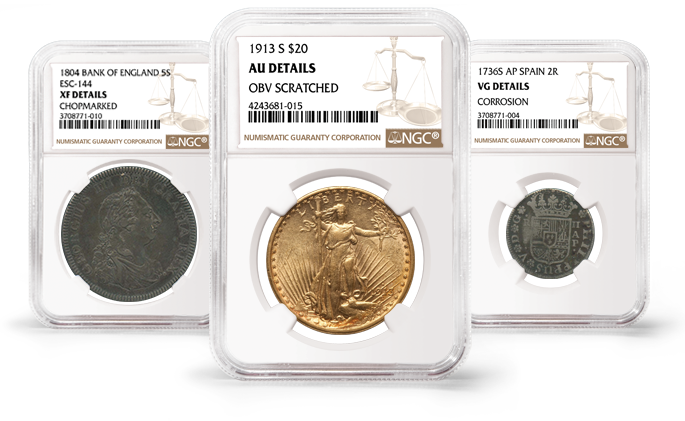
stamped into them. These are commonly referred to as CHOPMARKS. Damage confined to the coin’s rim or
border is specified as RIM DAMAGE.
Coins with minor SCRATCHES may be certified,
but a severe scratch will result in a No Grade verdict. A SOLDERED coin is one that has been used as an item
of jewelry and still displays evidence of this traditional
bonding agent. A coin removed from jewelry but still
showing evidence of this soldering will be returned
described as MOUNTED.
A BENT coin is one in which the planchet is no
longer level and has become curved or creased after the
minting process.
WHEEL MARKS occur when a coin counter has left
a mark on the coin leaving a highly polished spot.
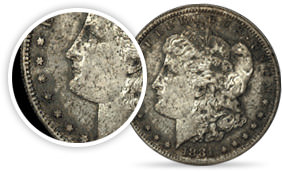
Corrosion, as shown on this Morgan dollar, will result in
a No Grade designation. |
 |
Improper storage can, over time, destroy the
surfaces of a coin. When a coin displays the negative
results of a hostile storage environment, but the
exact cause of this damage is not known, it is said to
have ENVIRONMENTAL DAMAGE. Environments
detrimental to coins are those featuring extremes of
heat and humidity, as well as atmospheric pollutants
and saltwater. Sea-salvaged and treasure coins are
often victims of environmental damage.
CORROSION is a problem for most metals, though
gold and platinum are nearly immune to its effects.
A natural chemical reaction, it causes the surfaces
of a coin to form new molecular compounds. When
corrosion is severe or unattractive, it will result in a
No Grade verdict.
GLUE RESIDUE is self-explanatory, but other
substances adhering to a coin’s surfaces, whatever
their nature, are categorized simply as RESIDUE.
A STAINED coin is one that displays a discoloration
as the result of some form of environmental damage.
This Peace dollar has a layer of PVC residue that is easily
observed. Note the “off” color of light green haze on the
coin’s surface. |
 |
The term PVC is an abbreviation for polyvinyl
chloride. PVC is a chemical compound used
to make plastics more pliable. It is commonly
found in the 2"x2" double-pocket envelopes, or “flips,”
used to store and display coins. Over time, PVC breaks
down, releasing a gas that may form a hazy, greenish
film on a coin. In extreme cases, this gas combines
with moisture in the air to create hydrochloric acid
that etches the coin’s surfaces, resulting in permanent
damage.
It may be possible to remove PVC from a coin’s
surface, depending on the depth of the PVC film, and
the length of time it has been on the coin. Only an
experienced professional should perform this work.
Improper PVC removal can result in a No Grade
designation of PVC DAMAGE or CLEANED.
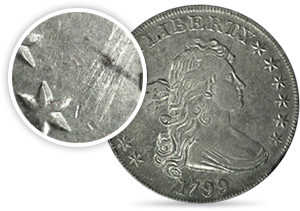
Improper Spot Removal can result in damage to a coin,
such as the scratch marks seen in the close-up, below, of
this 1799 dollar. |
 |
If a coin is brushed or polished in any way, this
will cause damage to its surfaces, and such a coin
is said to be IMPROPERLY CLEANED. Where
such action is harsh, it will mar or destroy the
natural luster and leave a scratchy, unnatural look.
NGC will not grade coins it considers to be harshly or
improperly cleaned.
Contaminant particles or spittle can result in black
spots appearing on a coin. Attempts to remove these
“carbon spots” through either chemical or mechanical
means may cause damage to the coin. Such pieces will
be returned with the notation SPOT REMOVALS.
A WIPED coin is one that has been rubbed with
a dry cloth or other abrasive material, leaving fine
“hairline” scratches on its surfaces. A BRUSHED coin
will display similar, but much heavier, abrasive lines.
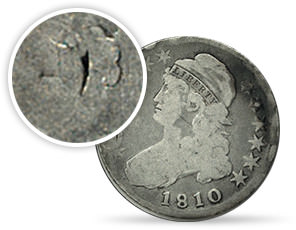
This Bust type silver half dollar from 1810 has been plugged. |
 |
A
coin restored through mechanical means is
described as being REPAIRED. There are
several reasons why a coin may be repaired.
Many older coins, particularly Bust type silver dollars
and gold dollars, were worn as jewelry. This often
caused them to be holed for suspension on a chain.
Subsequently, these coins were removed from the
chain and their holes PLUGGED. Though this work
is often skillfully performed, most experts will spot
the repair.
Coins used as jewelry may also be contained
within a circular bezel. While some bezels do no
harm to the coin, older ones often crimped the
coin’s rims at one or more points. Such coins may
later show evidence of RIM REPAIR. Similarly,
coins formerly mounted on items such as pins
and rings, will show traces of attachment. These
coins will be returned with the designation of MOUNT REMOVED.
Many rim repair coins have been filed to remove
irregular metal to even out the rims. This common
form of repair is referred to as RIM FILING.
TOOLING refers to either the smoothing of a coin’s
fields to remove scratches, corrosion, and other forms
of damage or the restoration of lost details through
use of a graver or knife. RE-ENGRAVED coins are
done in a similar fashion. However, the purpose is to strengthen lost detail through mechanical means.
This struck counterfeit 1916 S $5 gold piece is identified
as not genuine by its “S” mint mark, seen below, which is
the wrong shape and in the wrong position. |
 |
A
coin that was made by someone other than
the individual, business, or institution that
authorized it is NOT GENUINE or, more simply,
counterfeit. When a coin’s genuineness is uncertain,
it will be declared as being of QUESTIONABLE
AUTHENTICITY.
There are two basic kinds of counterfeits.
Circulating counterfeits are contemporary with the
coins they imitate and are intended to pass as money
at their face value. Numismatic counterfeits are
intended to deceive collectors and are typically made
years after the originals to sell at numismatic values.
An otherwise genuine coin may show an ALTERED
DATE to increase its apparent value. A coin may bear
an ADDED MINTMARK when that mint’s coins are
at a premium. If the Philadelphia Mint issue is worth
more than its branch mint counterparts, themay have a REMOVED MINTMARK.
Upon closer examination, the altered surfaces of this 1887
Sovereign are revealed. Note the artificial “frosting” added
on the coin’s devices to enhance its cameo appearance but
which have spilled over into the fields. |
 |
A
coin that has been treated in some way that
changes its general appearance is said to have ALTERED SURFACES. A coin’s surfaces can be
altered in many ways, but some of the more common
methods include whizzing and polishing, and adding “fill in” substances to hide defects.
A WHIZZED coin is one whose surfaces have been
treated with a rapidly rotating wire wheel in order to
make the coin appear to be brilliant uncirculated. A POLISHED coin could be buffed by hand or machine,
while a BURNISHED one is buffed by hand. In either
case, it is often performed in an attempt to remove
surface imperfections that could lower the coin’s
grade.
LACQUER is a clear chemical that is sometimes
applied to the surface of the coin to protect it. Over
time, however, this coating can crack, flake and
discolor, giving the coin an undesirable appearance.
In the past, countries lacquered coins at the mint
before shipping. Therefore, this process can occur at
the mint or afterwards.
As a general rule, NGC will not certify coins with minor
flaws such as rim clips or, in this case, lamination. |
 |
Coins are sometimes flawed as made. NGC, as a
general rule, will not grade coins having minor
flaws such as rim clips or laminations. Major
mint errors like off-centers and wrong planchets are
graded under NGC’s regular tiers as “Mint Error” coins.
PLANCHET FLAWS are the most common mint-
made defects that can result in a No Grade designation.
One of the most common is called a lamination (a
separation of the metal). RIM FLAWS are typically
due to errors in the planchet milling process, such as a CLIPPED PLANCHET, and may also be cause for a No
Grade return.
NGC will also not grade coins that have a small part
of the design missing, resulting in an ILLEGIBLE DATE or ILLEGIBLE MINTMARK. Such missing details are
typically due to the dies being excessively worn or filled
with grease. Major missing details due to filled dies that
affect a large portion of the coin are graded under NGC’s
regular tiers as “Mint Error” coins.
Coins such as this Silver Round are not eligible for
NGC certification. |
 |
NGC lists within its Service Guide the categories
of coins, tokens, and medals that it will certify.
While these include nearly all coins of the
United States, a wide range of World issues and a few
specific types of tokens and medals, certain types and
periods are excluded. Such items are designated NON-
ELIGIBLE TYPE.
To be certain that your coins, tokens, and medals
are eligible, check the NGC Service Guide or the NGC
Web site at www.NGCcoin.com for a current list of
eligible types and dates before submitting.
|