COINS REQUIRING CONSERVATION
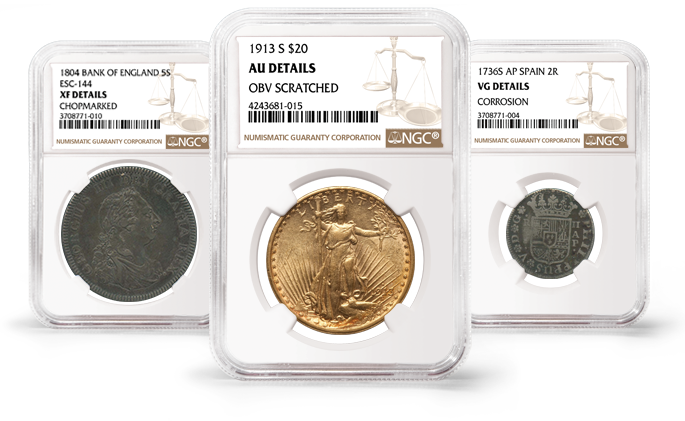
There are a handful of surface conditions that make a coin ineligible for NGC grading and encapsulation but can be improved through professional conservation. These include coins with heavy or destabilizing surface residues. Such contaminants can mask defects and break down overtime, degradation that can cause permanent and irreparable damage to these coins.
Fortunately, Numismatic Conservation Services (NCS) specializes in their removal and the neutralization of a coin’s surface. Once conserved by NCS, submitters can have their coins transferred to NGC for certification, where depending on their surface condition they may be either numerically or details graded.
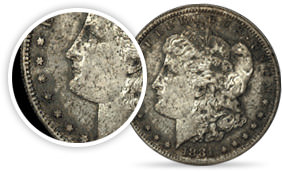
RESIDUE describes some surface contaminant that cannot be identified more specifically by NGC’s graders. OBV RESIDUE and REV RESIDUE provide a guide to the contaminant’s location when it appears on just one side. With proper conservation, such residue may be removable before it results in environmental damage.
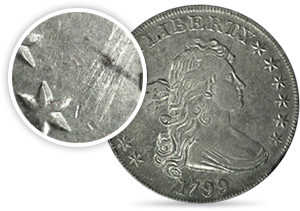
GLUE RESIDUE is self-explanatory, and may be treatable with proper conservation. NGC’s graders may narrow this down to read OBV GLUE or REV GLUE. Such coins should be submitted to NCS for removal of this material.
LACQUERED coins have had a coat of clear lacquer applied in an attempt to prevent tarnishing, a common practice in past decades. The terms OBV LACQUER and REV LACQUER provide greater specificity. Proper conservation by NCS may be able to remove this contaminant.
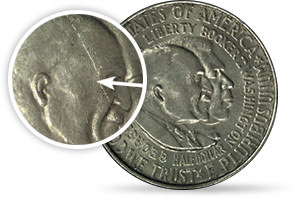
PVC DAMAGE indicates that a coin has been irreparably harmed by environmental reaction to the chemical plasticizer in plastic coin holders. Polyvinyl chloride (PVC) is a widely used thermoplastic that has many applications. In the numismatic field it is found in the manufacture of “flips,” the transparent, dual-pocket envelopes used by dealers, collectors and grading services for displaying and handling coins. This plastic is safe enough for short-term use, but long-term storage brings with it a serious hazard. To make PVC flexible, it is impregnated with a chemical plasticizer that, over time, separates from the PVC base and may form a green film on the surface of a coin. If left untreated, the plasticizer combines with moisture in the air to create hydrochloric acid that etches the coin’s surfaces. When caught in time, the PVC contaminant may be removable through NCS conservation.
PVC film on a coin’s surfaces will preclude encapsulation by NGC, as this continues to be an active contaminant and may cause further damage. Such coins should be sent to NCS for removal of PVC through proper conservation.
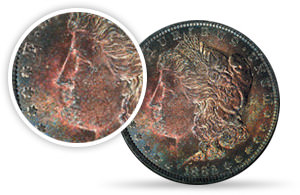
DIP RESIDUE describes a coloration that results from a coin being chemically cleaned (dipped) to remove toning and not properly rinsed off afterward. This makes the coin have a cloudy or brown unnatural look.
 |
This Peace dollar has a layer of PVC residue that is easily observed. Note the “off” color of light green haze on the coin’s surface. |